Generated with AI3 min read
Measuring Tools
Brief description
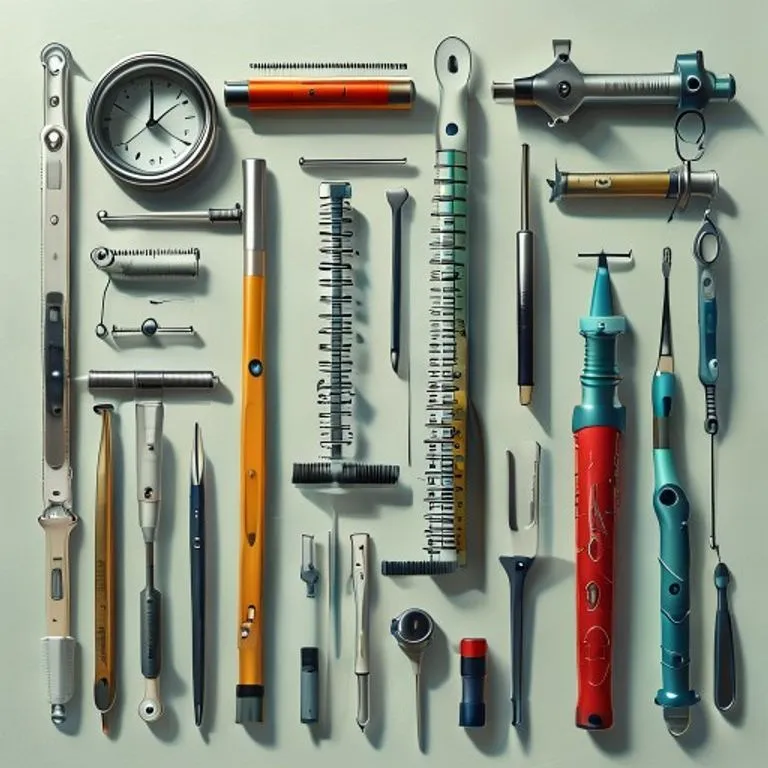
Measuring tools are instruments designed to quantify physical magnitudes such as length, mass, time, temperature, and angles. They are the foundation of engineering, trade, navigation, and science, allowing for standardization and reproducibility in construction and exchange.
Use / Function
- Construction: Ensuring structures are straight, level, and of correct dimensions (ruler, plumb bob, level).
- Trade: Quantifying goods for fair exchange (balance scale, measuring container).
- Navigation: Determining position and direction (compass, sextant, chronometer).
- Timekeeping: Organizing daily activities and agriculture (sundial, calendar).
- Science: Observing and recording natural phenomena (thermometer, barometer).
- Scale: Individual to Industrial.
Temperature Measurement
Temperature measurement is crucial for chemical processes, cooking, medicine, and weather prediction.
- Thermometer: Uses the thermal expansion of liquids (mercury, alcohol) or solids to indicate temperature on a graduated scale. It allows for precise process control and health safety.
- Anemometer: Measures wind speed using rotating cups, vanes, or ultrasonic sensors, crucial for weather prediction, aviation, and wind energy.
- Rain Gauge: Collects and measures precipitation over time to monitor rainfall, essential for agriculture, hydrology, and climate studies.
- Thermocouple: For extreme temperatures or rapid digital measurements.
Horizontal Measurement
Determining true horizontality is crucial for leveling foundations, floors, and structures, ensuring their stability and functionality.
- Level: Uses an air bubble in a liquid (spirit level) or the principle of communicating vessels (water level) to indicate if a surface is horizontal.
Vertical Measurement
Determining the true vertical is essential for the stability of any structure.
- Plumb Bob: The simplest and most ancient tool, using gravity to define a vertical line.
- Level: Can be used vertically to check plumb.
Operating principle
All measuring tools work on the principle of comparison against a standard.
- Direct comparison: Placing the object next to the standard (e.g., a ruler against a board).
- Indirect comparison: Using a mechanism to translate the property into a readable value (e.g., a spring scale or thermometer).
How to create it
Creation varies by tool, but generally involves:
- Establishing a Standard: Defining a unit (e.g., the length of a king’s foot, a specific stone’s weight).
- Replication: Creating tools that match this standard.
- Calibration: Checking the tool against the standard to ensure accuracy.
- Technical level: Basic (ruler, plumb bob) to Advanced (micrometer, chronometer).
Materials needed
- Essential: Stable materials that do not warp or change easily with temperature or humidity (hardwood, metal, stone).
- Tools: Carving tools, scribes for marking.
- Substitutes: Body parts (hand span, foot) for rough estimates.
Variants and improvements
- Linear: Ruler, Tape measure, Calipers, Micrometer.
- Angular: Protractor, Sextant, Theodolite.
- Mass/Weight: Balance scale, Spring scale.
- Volume: Measuring Container.
- Leveling: Plumb bob, Spirit level, Water level.
- Time: Sundial, Water clock, Pendulum clock, Mechanical Watch.
- Environmental: Anemometer, Rain Gauge, Thermometer, Barometer, Wind Vane.
Limits and risks
- Calibration Drift: Tools can lose accuracy over time due to wear or environmental changes.
- Parallax Error: Incorrect viewing angle can lead to reading errors.
- Temperature Expansion: Materials expand/contract with heat, affecting precision instruments.