Generated with AI2 min read
Protractor
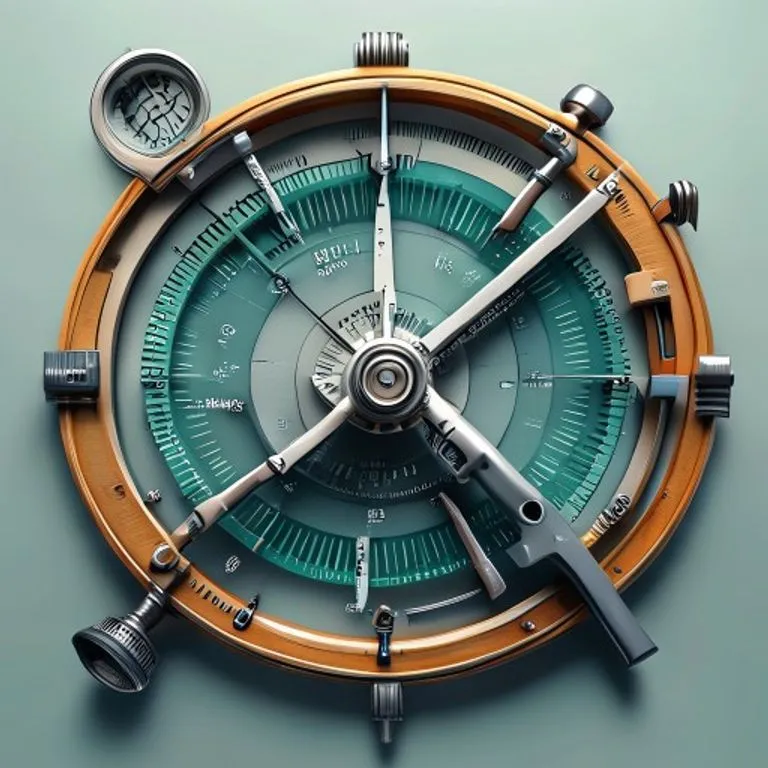
Brief description
A protractor is a measuring instrument used for constructing and measuring angles. It is typically a semicircular tool marked with degrees, essential in geometry, drafting, navigation, and construction.
Use / Function
- Measuring Angles: Determining the degrees of an existing angle.
- Drawing Angles: Creating precise angles for blueprints or layouts.
- Navigation: Used with maps to determine bearings (course).
- Scale: Individual.
Operating principle
It is based on the division of a circle into 360 degrees. A standard protractor is a half-circle (180 degrees). The center point is aligned with the vertex of the angle, and the baseline is aligned with one side. The other side of the angle indicates the measurement on the curved scale.
How to create it
Basic Protractor
- Materials: A flat, stiff material (wood, metal, or even heavy paper).
- Creation: Draw a perfect circle using a compass. Draw a diameter line through the center.
- Marking: This is the hard part. Divide the semicircle (180 degrees) into equal parts.
- 90 degrees is perpendicular to the diameter.
- 60 degrees is the length of the radius marked from the edge.
- Bisect angles to get 45, 30, 15, etc.
- Technical level: Intermediate (requires geometric knowledge).
Materials needed
- Essential: Flat sheet material.
- Tools: Compass for drawing circles, straightedge, fine marker or scribe.
- Substitutes: Folding a paper circle can give 90, 45, 22.5 degree references.
Variants and improvements
- Bevel Protractor: Has a pivoting arm for measuring angles on physical objects (like a machined part).
- Full Circle Protractor: 360 degrees, used often in navigation.
- Clinometer: A protractor with a plumb bob, used to measure vertical angles (slopes, tree heights).
Limits and risks
- Precision: Depends entirely on the accuracy of the markings.
- Size: Larger protractors allow for more precise degree markings.
- Parallax: Reading from an angle can distort the measurement.