Generated with AI3 min read
Calipers
Made of
Brief description
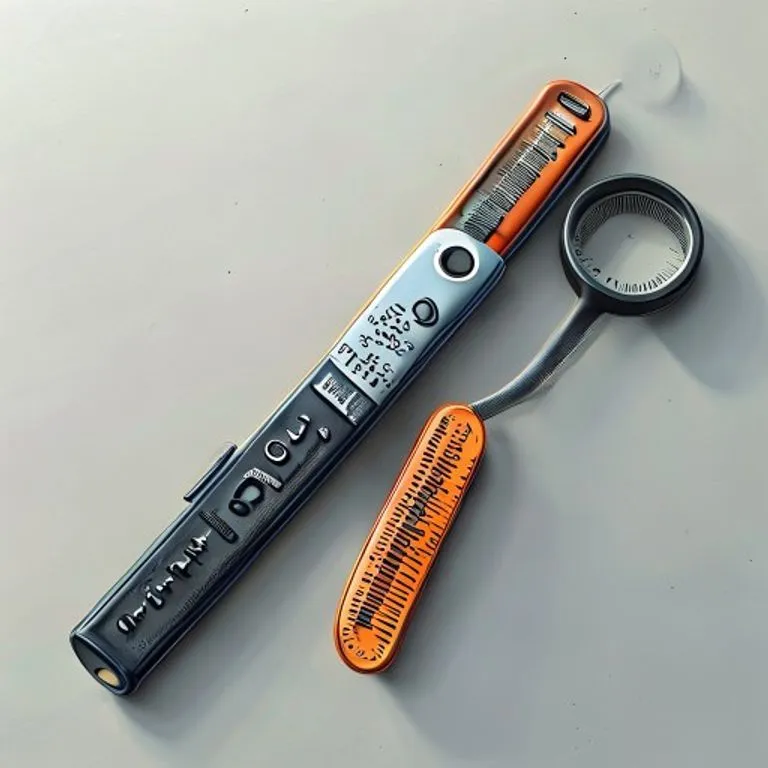
Calipers are precision instruments used to measure the distance between two opposite sides of an object. They are crucial in mechanical engineering, metalworking, and woodworking for measuring internal and external dimensions with high accuracy.
Use / Function
- External Measurement: Measuring the outer diameter or thickness of an object (using the main jaws).
- Internal Measurement: Measuring the inner diameter of a hole or tube (using the smaller upper jaws).
- Depth Measurement: Measuring the depth of a hole (using the depth probe at the end).
- Scale: Individual to Industrial.
Operating principle
The device consists of a main scale (fixed) and a sliding jaw. The object is placed between the jaws, and the sliding jaw is moved until it lightly touches the object. The measurement is read from the scale.
- Vernier Scale: A secondary sliding scale that allows readings between the main scale markings, increasing precision (e.g., to 0.1mm or 0.02mm).
How to create it
Basic Sliding Caliper
- Materials: Hardwood or metal strips.
- Assembly: Create a T-shaped fixed piece (main beam and fixed jaw). Create a sliding piece with a matching jaw that fits snugly over the beam.
- Marking: Carefully mark standard units (mm/inches) on the beam.
Vernier Caliper
- Materials: High-quality steel or brass.
- Assembly: Similar to the basic version but requires precise machining for the sliding mechanism and jaws.
- Vernier: The sliding scale must have markings spaced slightly differently than the main scale (e.g., 10 divisions on the vernier equal 9 divisions on the main scale).
- Technical level: Intermediate (Basic) to Advanced (Vernier).
Materials needed
- Essential: Hard, stable material (steel, brass, or very hard wood) to prevent wear and flexing.
- Tools: Precision cutting and filing tools, scribes for marking.
- Substitutes: A ruler can be used for rough measurements, but lacks the ability to clamp or measure internal diameters easily.
Variants and improvements
- Vernier Caliper: The standard mechanical precision tool.
- Dial Caliper: Uses a gear mechanism and a dial for easier reading.
- Digital Caliper: Uses electronic sensors and a display.
- Micrometer: A screw-based instrument for even higher precision.
Limits and risks
- Wear: The jaws can wear down over time, affecting accuracy.
- Force: Applying too much pressure can compress the object or flex the caliper, giving a false reading.
- Parallax: Reading the scale from an angle can cause errors (less of an issue with dial/digital).