Generated with AI2 min read
Water Clock
Brief description
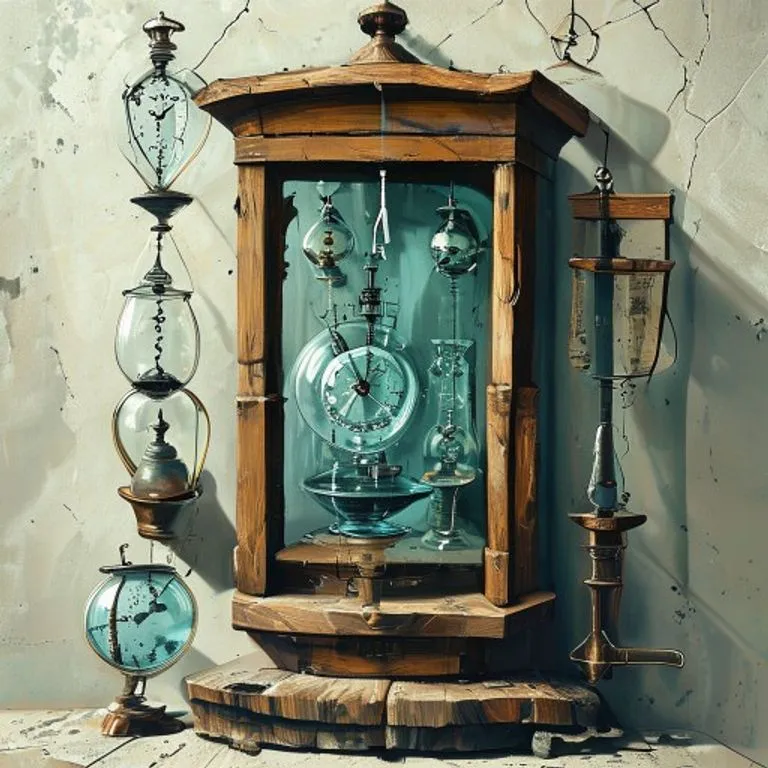
A water clock, or clepsydra, is a timepiece that measures time by the regulated flow of liquid into (inflow type) or out of (outflow type) a vessel.
Use / Function
- Timekeeping: Measuring time independent of the sun (works at night and indoors).
- Regulation: Limiting the time for speeches in courts (historical use).
- Scale: Personal to Civic.
Operating principle
It relies on the predictable rate of flow of water.
- Outflow: Water drips out of a container. As the level drops, the pressure decreases, slowing the flow (a problem to solve).
- Inflow: Water drips into a container with markings. If the source has a constant head (pressure), the filling rate is constant.
How to create it
- Reservoir: Create a large container for water.
- Orifice: Drill a small, precise hole near the bottom.
- Receiver: Place a container below to catch the water.
- Calibration: Mark levels on the receiver corresponding to time intervals (using a sundial as reference during the day).
- Constant Head (Improvement): Use an overflow mechanism to keep the water pressure constant in the source container.
- Technical level: Basic to Intermediate.
Materials needed
Variants and improvements
- Simple Bowl: A bowl with a hole that sinks in a larger tub in a set time.
- Inflow Clepsydra: Measures water filling up, often with a float to drive gears or indicators.
- Mechanical Water Clock: Water flow powers a mechanism (escapement) to move hands.
Limits and risks
- Temperature: Viscosity of water changes with temperature, affecting flow rate. Freezing stops it.
- Evaporation: Loss of water over time.
- Clogging: Impurities in water can block the orifice.