Generated with AI3 min read
Barometer
Brief description
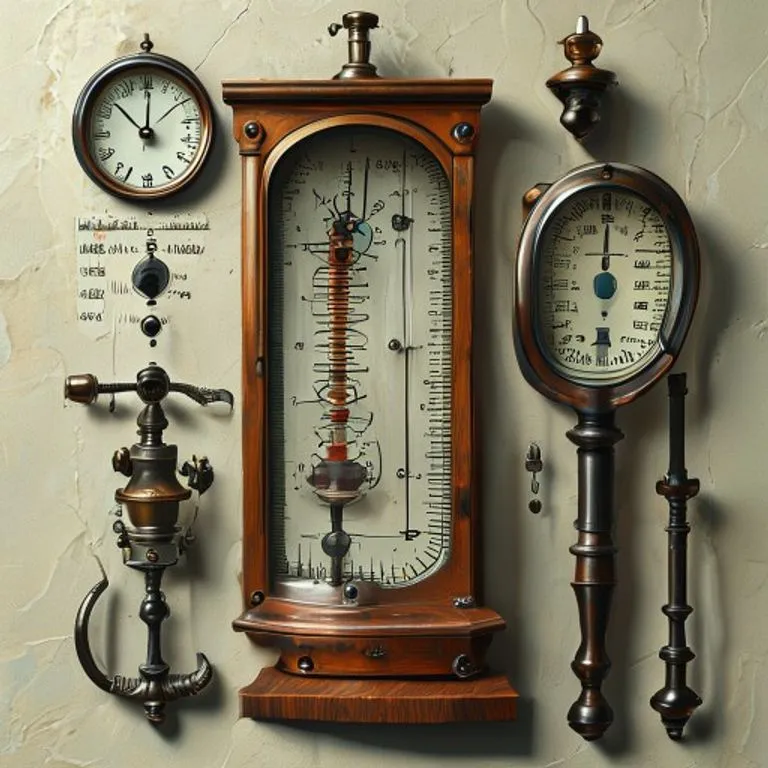
A barometer is a scientific instrument used to measure atmospheric pressure. It is a critical tool for predicting short-term weather changes and measuring altitude.
Use / Function
- Weather Forecasting: High pressure generally indicates fair weather, while low pressure indicates storms. Rapid pressure drops are a warning sign.
- Altimetry: Measuring altitude above sea level (pressure decreases with height).
- Scale: Individual to Industrial.
Operating principle
The atmosphere exerts weight (pressure) on the surface of the earth. A barometer balances this weight against a column of liquid (mercury or water) or a mechanical spring.
- Mercury Barometer: Atmospheric pressure pushes down on a reservoir of mercury, forcing it up a vacuum-sealed tube. The height of the column is directly proportional to the pressure.
How to create it
Torricellian Barometer
- Materials: A glass tube at least 80cm long (sealed at one end), a small bowl, and mercury.
- Assembly: Fill the tube completely with mercury to remove all air. Fill the bowl partly with mercury.
- Inversion: Place your thumb over the open end, invert the tube, and submerge the opening in the bowl of mercury before releasing your thumb.
- Result: The mercury will drop slightly, creating a vacuum at the top. The height of the column (usually around 760mm at sea level) represents the atmospheric pressure.
Water Barometer (Goethe)
- Materials: A glass jar with a spout connected to the main body (like a teapot but sealed at the top).
- Principle: Traps a volume of air. When external pressure rises, it pushes water down the spout and into the body. When pressure falls, the trapped air pushes water up the spout.
- Technical level: Advanced (Mercury) to Basic (Water/Goethe).
Materials needed
- Essential: Glass tubing, liquid (mercury is standard, water requires a 10m tube for accuracy or a Goethe design for relative changes).
- Tools: Heat source for sealing glass.
- Substitutes: An aneroid barometer uses a flexible metal box with a vacuum inside, which expands/contracts with pressure (requires precision machining).
Variants and improvements
- Aneroid Barometer: Non-liquid, uses a metal cell. More durable and portable.
- Barograph: Records pressure changes over time on a paper chart.
- Storm Glass: A chemical mixture (camphor, alcohol, etc.) that crystallizes differently based on weather (though accuracy is debated).
Limits and risks
- Toxicity: Mercury is extremely toxic. Handled with great care.
- Fragility: Glass tubes break easily.
- Temperature: Readings must be corrected for temperature, as liquids expand with heat.