Generated with AI2 min read
Pendulum Clock
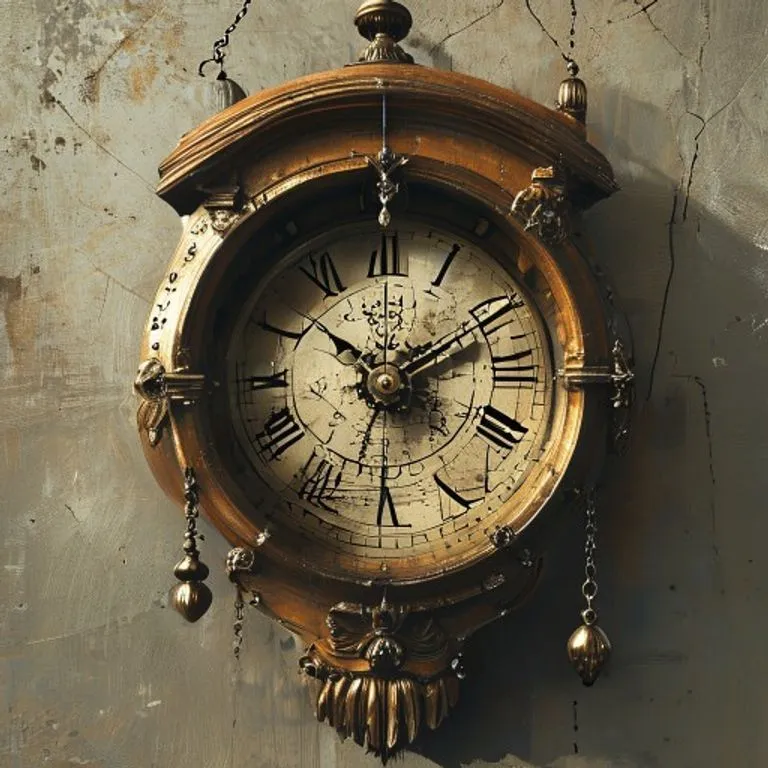
Brief description
A mechanical device that uses a swinging weight (pendulum) as a timekeeping element. Its advantage lies in its precision, much higher than sundials or water clocks, allowing for accurate measurement of seconds and minutes.
Use / Function
- Precision Timekeeping: Measuring time with an error of seconds per day.
- Science and Navigation: Fundamental for physical experiments and, in advanced versions (marine chronometers), for navigation.
- Social Coordination: Standardization of schedules in cities and stations.
Operating principle
Based on the isochronism of the pendulum: the period of oscillation depends on its length, not amplitude (for small angles).
- Energy Source: A falling weight or coiled spring provides energy.
- Gear Train: Transmits energy and counts oscillations.
- Escapement: The key mechanism (like the anchor escapement) that gives a small push to the pendulum to keep it swinging and allows the gears to advance a fixed amount with each swing.
How to create it
- Pendulum: A long rod with an adjustable weight at the end.
- Escapement Mechanism: Build an escape wheel (saw-toothed) and an anchor that locks and releases the wheel to the rhythm of the pendulum.
- Weights: A system of weights and pulleys to drive the gear train.
- Dial: A gear reduction system to move hour and minute hands.
Materials needed
- Essential: Metal (brass or iron) for gears and escapement, wood for structure and pendulum rod.
- Tools: Precision files, drill, lathe (for axles and wheels).
- Substitutes: Basic wooden versions can be made, but friction and humidity will affect accuracy.
Variants and improvements
- Anchor Escapement: Improves accuracy by requiring less oscillation amplitude.
- Temperature Compensated Pendulum: Uses different metals (like the gridiron pendulum) to counteract thermal expansion.
- Cuckoo Clock: Decorative variant with automata.
Limits and risks
- Immobility: Must remain stationary and level; movement alters the pendulum’s period (useless on ships without complex modifications).
- Friction: Requires regular lubrication and cleaning.
- Length: For a 2-second period (1 sec swing each way), the pendulum must be nearly 1 meter long.