Generated with AI3 min read
Plumb Bob
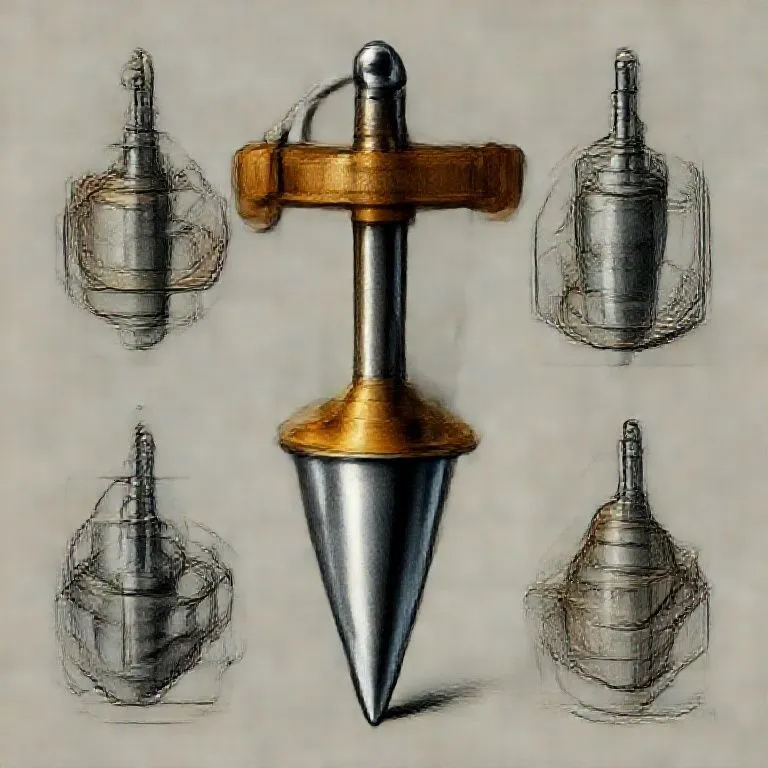
Brief description
A plumb bob is a weight, usually with a pointed tip at the bottom, suspended from a string and used as a vertical reference line. It is a fundamental tool in construction, surveying, and navigation to determine verticality.
Use / Function
- Construction: Ensuring that walls, columns, and door frames are perfectly vertical.
- Surveying: Projecting points from the ground upwards or vice versa (centering the instrument over a specific point).
- Navigation: Measuring water depth (sounding lead).
- Astronomy: Establishing the local zenith.
Operating principle
The plumb bob works due to gravity. The weight of the bob pulls the string taut, and due to Earth’s gravitational pull, the string hangs exactly vertical, perpendicular to the horizontal plane. The pointed tip allows for millimeter precision when pointing to a spot on the ground.
How to create it
- Obtain a weight: Find a dense, symmetrical object. Lead is ideal due to its density and ease of molding.
- Shape (optional but recommended): If possible, mold the weight into a cone or inverted pyramid shape to have a precise tip.
- Attach the string: Tie a strong string to the center of the top of the weight. It is crucial that the string exits exactly from the center of gravity so the bob does not hang crooked.
- Block or holder (optional): For masonry use, a piece of wood or metal of the same width as the bob can be added to the top of the string, allowing it to be rested against a wall to check verticality.
Materials needed
- Essential:
- Weight: Lead, brass, iron, or a symmetrical stone.
- String: Strong thread, twine, or thin rope that does not stretch too much.
- Tools: Knife to cut the string, mold if casting lead.
Variants and improvements
- Mason’s Plumb Bob: Includes a plate (block) of the same thickness as the bob to facilitate checking walls.
- Point Plumb Bob: With a hardened steel tip for greater precision in surveying.
- Optical/Laser Plumb: Modern versions that use light instead of a physical string.
- Sounding Lead: Plumb bob with a cavity in the base filled with tallow to pick up samples from the seabed.
Limits and risks
- Wind: Wind can move the string, making measurement inaccurate outdoors.
- String Length: At great heights, the string can oscillate significantly and take time to stabilize.
- Magnetism: If an iron bob is used near strong magnets, it could be deflected (uncommon).
- Toxicity: If made of lead, wash hands after use and avoid constant handling without protection.