Generated with AI3 min read
Thermometer
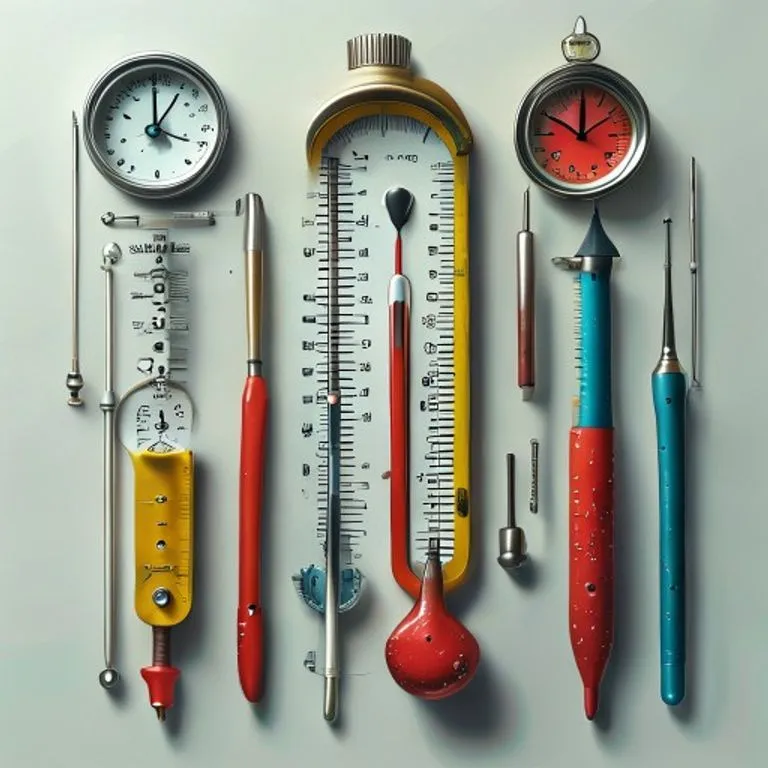
Brief description
A thermometer is an instrument used to measure temperature or temperature gradient. It is essential for monitoring weather, cooking, medical diagnosis, and scientific experiments.
Use / Function
- Meteorology: Measuring air and soil temperature to predict weather patterns.
- Medicine: Monitoring body temperature to detect fever and illness.
- Cooking: Ensuring food is cooked to safe temperatures.
- Industry: Monitoring processes that require specific thermal conditions.
- Scale: Personal to Industrial.
Operating principle
Most traditional thermometers rely on the principle of thermal expansion.
- Expansion: A liquid (like mercury or alcohol) or a solid (bimetallic strip) expands when heated and contracts when cooled.
- Constraint: The material is constrained in a narrow tube or fixed configuration, so the expansion translates into visible movement along a scale.
- Readout: The level of the liquid or the position of the needle corresponds to a specific temperature value based on calibration.
How to create it
Creating a basic liquid-in-glass thermometer:
- Tube Preparation: A glass tube with a very fine bore (capillary) is required. A bulb is blown at one end.
- Filling: The bulb and part of the tube are filled with a liquid (alcohol dyed red is common and safer than mercury).
- Sealing: The liquid is heated to expand it to the top of the tube to expel air, and then the top is sealed shut.
- Calibration:
- Place in melting ice: Mark this point as 0°C (32°F).
- Place in boiling water (at sea level): Mark this point as 100°C (212°F).
- Divide the distance between these points into equal degrees.
- Technical level: Intermediate (requires glassblowing skills).
Materials needed
- Essential:
- Glass tubing: Uniform bore is critical for accuracy.
- Expansion liquid: Alcohol (ethanol) or Mercury (toxic, use with caution).
- Tools: Heat source (torch) for glassworking, scale marking tools.
- Substitutes:
- Bimetallic strip: Two different metals bonded together that curl when heated (used in dial thermometers).
- Galileo thermometer: Uses glass spheres of different densities in a liquid.
Variants and improvements
- Liquid-in-glass: The classic design.
- Bimetallic: Robust, used in ovens and outdoor dials.
- Thermocouple: Modern, uses electrical voltage generated by dissimilar metals (Seebeck effect).
- Infrared: Measures thermal radiation from a distance (non-contact).
Limits and risks
- Range: Alcohol boils at ~78°C, so it cannot measure high temperatures (use mercury or bimetallic for that). Mercury freezes at -39°C.
- Fragility: Glass thermometers break easily.
- Toxicity: Mercury is highly toxic if the thermometer breaks.
- Calibration: Needs to be checked periodically; air pressure affects boiling point calibration.