Generated with AI2 min read
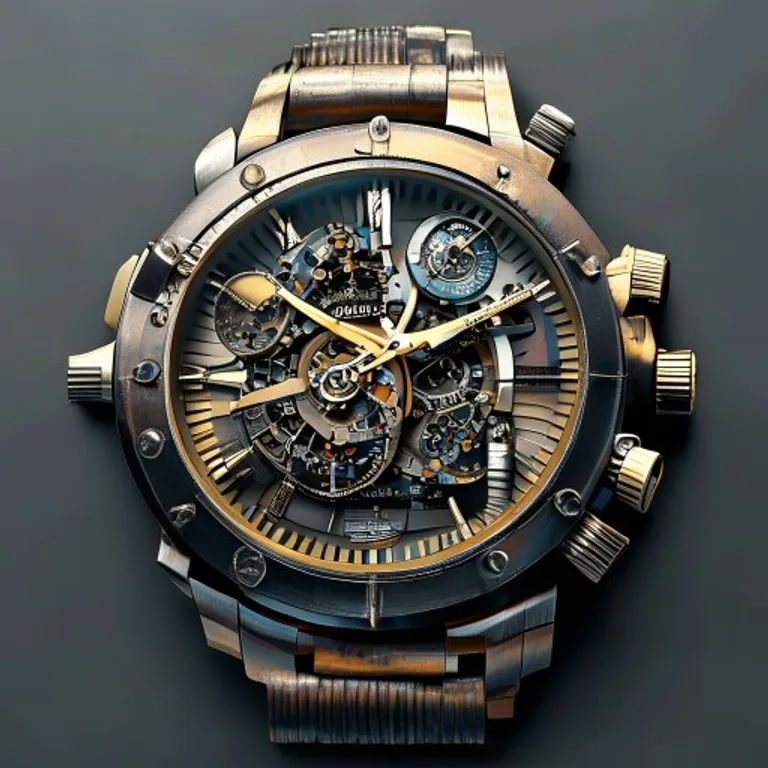
Mechanical Watch
Brief description
A portable timekeeping device driven by a mainspring and regulated by a Balance Wheel. It allows for personal time management and coordination on the go.
Use / Function
- Personal Timekeeping: Knowing the time of day anywhere.
- Coordination: Synchronizing activities between people at different locations.
- Navigation: Rough estimation of longitude (less precise than a chronometer).
Operating principle
Stores energy in a wound spring (mainspring) which is released through a gear train. The speed of release is controlled by an Escapement mechanism and a balance wheel that oscillates back and forth at a constant rate.
- Energy Source: Mainspring.
- Transmission: Gear train (wheels and pinions).
- Regulation: Balance wheel and hairspring (isochronism).
- Escapement: Locks and unlocks the gear train, counting oscillations.
- Indication: Hands moving on a dial.
How to create it
Requires high precision micro-mechanics.
- Plates and Bridges: To hold the moving parts.
- Gear Train: To transmit power and divide time.
- Escapement: Lever or cylinder escapement.
- Balance Assembly: The heart of the watch.
- Case: To protect the movement.
Materials needed
- Essential: Brass (plates, gears), Steel (pinions, springs, screws), Glass (crystal).
- Tools: Lathe, staking tool, tweezers, screwdrivers, loupe.
- Substitutes: Early watches used iron; jewels (rubies) are used for bearings to reduce friction.
Variants and improvements
- Pocket Watch: Carried in a pocket.
- Wristwatch: Worn on the wrist (requires shock protection).
- Automatic: Self-winding via a rotor.
- Quartz: Electronic successor.
Limits and risks
- Fragility: Shock, water, and magnetism can stop or damage it.
- Maintenance: Needs cleaning and oiling every few years.
- Accuracy: Varies by seconds per day (unlike quartz).