Generated with AI3 min read
Steam Engine
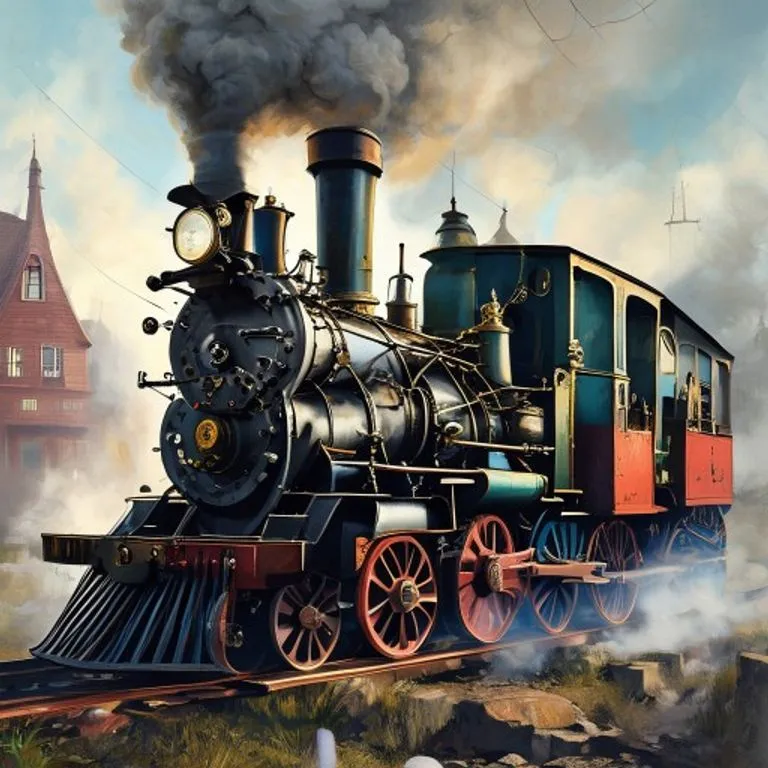
Brief description
A heat engine that performs mechanical work using steam as its working fluid. The steam engine uses the force produced by steam pressure to push a piston back and forth inside a cylinder. This reciprocating motion is typically converted into rotational motion for work.
Use / Function
- Primary Use: To power machinery (pumps, mills, factories) and transportation (trains, ships).
- Secondary Uses: Generating electricity (steam turbines are modern descendants).
- Scale: From small models to massive stationary engines and locomotives.
Operating principle
- Boiling: Water is heated in a Boiler to create high-pressure steam.
- Expansion: The steam enters a cylinder through a valve and expands, pushing a piston.
- Work: The moving piston pushes a connecting rod, which turns a crankshaft (converting linear to rotary motion).
- Exhaust: The spent steam is exhausted (vented to the atmosphere or condensed).
- Cycle: The process repeats. A Flywheel carries the momentum through the “dead spots” of the cycle.
How to create it
Basic Double-Acting Engine
- Cylinder: A smooth, bored tube of Cast Iron.
- Piston: A disk that fits tightly inside the cylinder, often with rings to seal the steam.
- Valves: A mechanism (slide valve or piston valve) to admit steam to one side of the piston while exhausting it from the other, then switching at the end of the stroke.
- Crankshaft & Flywheel: Converts the back-and-forth motion to rotation. The heavy Flywheel is crucial for smooth operation.
- Governor: A device (often a centrifugal governor) to regulate the speed by controlling the steam flow.
Materials needed
- Boiler/Cylinder: Iron or Steel (must withstand high pressure).
- Piston/Valves: Cast Iron, Brass, or Bronze.
- Bearings: Slide Bearings (Bronze/Babbitt).
- Seals: Leather, Rope (packing), or metal rings.
- Fuel: Coal, Wood, or Oil.
- Working Fluid: Water (clean, soft water to prevent scale).
Variants and improvements
- Atmospheric Engine (Newcomen): Used steam to create a vacuum; atmospheric pressure did the work. Very inefficient.
- High-Pressure Engine (Watt/Trevithick): Uses steam pressure above atmospheric. Much smaller and more powerful.
- Compound Engine: Steam is used in one cylinder, then exhausted into a larger cylinder to extract more energy.
- Steam Turbine: Steam spins blades directly (no piston). Used in power plants today.
Limits and risks
- Explosion: Boiler explosions are catastrophic. Safety valves and regular inspection are mandatory.
- Efficiency: Early engines were very inefficient (1-5%). Modern turbines are much better but still limited by thermodynamics.
- Maintenance: Requires constant lubrication, cleaning (boiler scale), and seal replacement.