Generated with AI2 min read
Piston
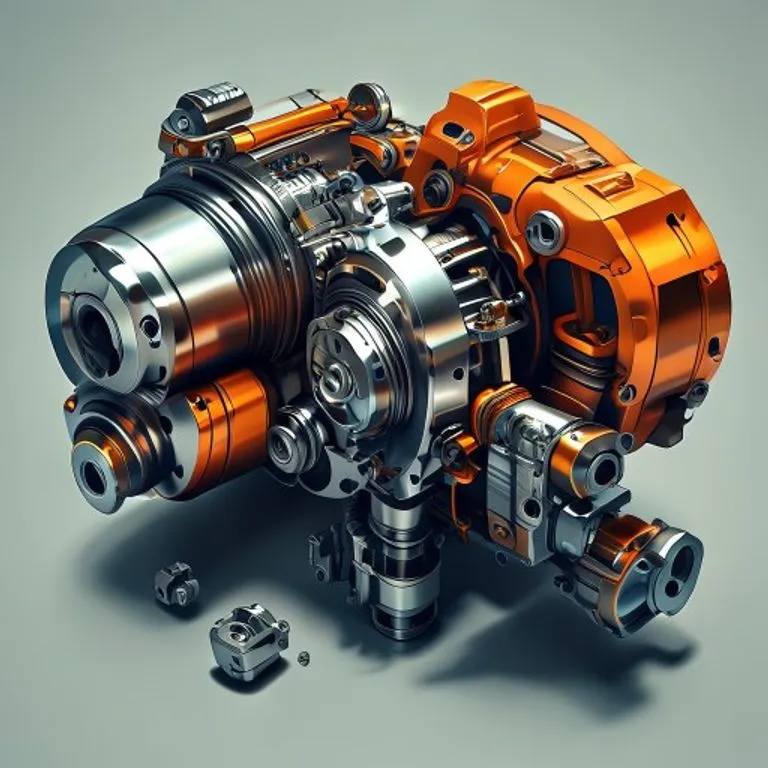
Brief description
A component of reciprocating engines, reciprocating pumps, gas compressors, hydraulic cylinders and pneumatic cylinders, among other similar mechanisms. It is the moving component that is contained by a cylinder and is made gas-tight by piston rings.
Use / Function
- Primary Use: To transfer force from expanding gas in the cylinder to the crankshaft via a piston rod and/or connecting rod (in an engine) OR to transfer force from the crankshaft to the fluid in the cylinder for the purpose of compressing or pumping the fluid (in a pump).
Operating principle
- In an Engine: Expanding gas (combustion or steam) pushes against the piston head, forcing it down the cylinder. This linear motion is converted to rotary motion.
- In a Pump: The piston is pulled/pushed, creating a vacuum (suction) or pressure (compression) to move a fluid.
How to create it
Simple Piston
- Head (Crown): The top surface that withstands the pressure/heat. Usually Cast Iron or Aluminum (lighter).
- Skirt: The side walls that guide the piston in the cylinder bore.
- Pin (Wrist Pin): A hollow steel shaft that connects the piston to the connecting rod.
- Rings: Cast Iron or Steel rings that fit into grooves on the piston. They spring outward to seal against the cylinder wall, preventing gas blow-by and scraping oil.
Materials needed
- Piston: Cast Iron (durable, heat resistant), Aluminum (light, good heat conduction), or Steel.
- Rings: Cast Iron or Chrome-plated Steel.
- Pin: Hardened Steel.
Variants and improvements
- Trunk Piston: Standard design (like in a car engine).
- Crosshead Piston: Used in large engines (ships/steam); the piston rod connects to a crosshead which slides in guides, taking the side thrust off the piston.
- Plunger: A solid cylinder used in pumps; simpler to seal.
Limits and risks
- Seizure: If the piston expands more than the cylinder (due to heat), it can get stuck (seize), destroying the engine. Clearance is critical.
- Slap: If the clearance is too loose, the piston rocks and makes noise (piston slap).
- Blow-by: Worn rings allow gas to leak past, reducing power and contaminating oil.
Related Inventions
- Steam Engine
- Pump
- Slide Bearings (Connecting rod bearings)
- Flywheel