Brick
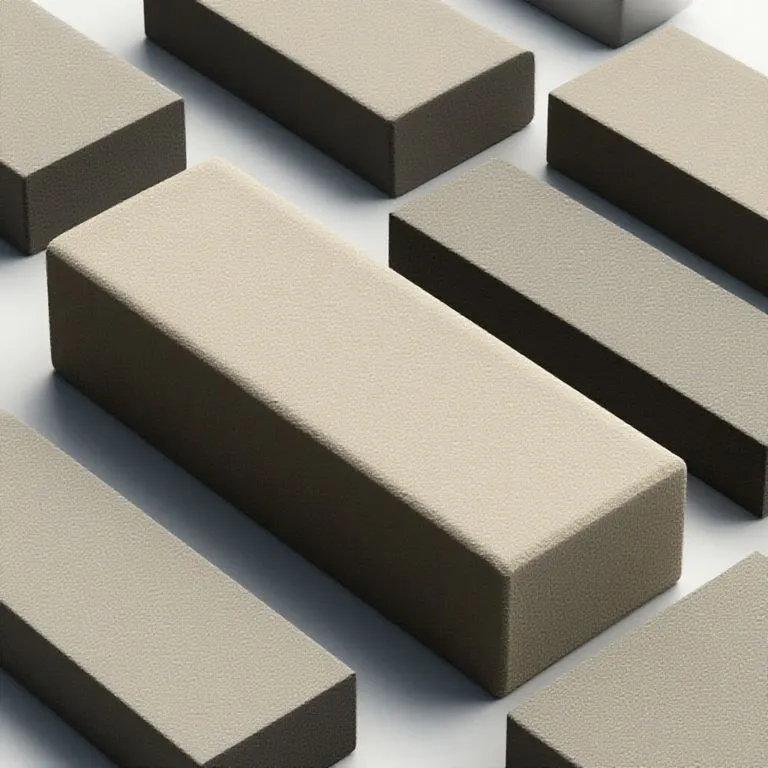
A brick is a block of ceramic material or concrete, primarily used in masonry to build walls, foundations, arches, and other structures. It is one of the oldest and most versatile construction materials.
Description of what it is like
Generally, it has a rectangular parallelepiped shape. Its color varies depending on the clay composition and the firing process, ranging from intense red to yellowish or brown tones. They are hard, rough to the touch, and heavy for their size.
Origin and where to find it
Bricks are not found in nature; they must be manufactured. However, their main components are very common:
Minimum processing required
To obtain a useful brick:
- Extraction and preparation: Clean the clay of stones and unwanted organic matter.
- Mixing: Mix the clay with water (and sometimes sand or straw) until a homogeneous plastic mass is obtained.
- Molding: Shape the mass using wooden or metal molds (or manually).
- Drying: Let the raw bricks (adobe) dry outdoors protected from rain to eliminate moisture.
- Firing (Optional but recommended): Heat the dry bricks in a kiln (between 900°C and 1000°C) to vitrify them and make them water-resistant and more durable.
Tools needed to work on it
- Shovels and picks: To extract the earth.
- Molds: Wooden or metal to give uniform shape.
- Kiln: For firing (if fired brick is desired).
- Trowel: To place the mortar and settle the bricks during construction.
Common forms of use
- Load-bearing walls: Solid bricks joined with mortar.
- Partitions: Hollow bricks (lighter) for interior divisions.
- Arches and vaults: Taking advantage of their compressive strength.
- Kilns and chimneys: Refractory bricks (special clay) that withstand high temperatures.
- Paving: Paths and driveways (Roads).
Insulation and Efficiency
Bricks have high thermal mass (they store heat) but are poor insulators (heat passes through them easily). To improve energy efficiency, they are almost always used with insulation:
- Cavity Walls: Two layers of brick (or brick + block) with a 50-100mm gap in between. This gap is filled with Mineral Wool, Polystyrene beads, or Vermiculite to prevent heat loss while maintaining a weather-proof outer skin.
- External Wall Insulation (EWI): A layer of rigid insulation (Polystyrene or Polyurethane) is fixed to the outside of an old solid brick wall and covered with render.
- Internal Insulation: Insulated plasterboard applied to the inner face, though this reduces room size and can cause condensation issues if not carefully managed.
Possible substitutes
- Stone: Harder to work and give regular shape, but very resistant.
- Wood: Lighter and flexible, but less resistant to fire and moisture.
- Concrete blocks: Faster to place, but require cement.
- Rammed earth (Tapial): Similar composition but built in large formworks.
Limitations and common failures
- Moisture: Porous brick can absorb water, which can cause frost damage (water freezes and breaks the brick).
- Poor mortar: The strength of a brick wall depends as much on the brick as on the mortar that joins it.
- Lack of bonding: If bricks are not placed overlapping (bonded), the wall will be unstable.
Risks and safety
- Collapses: During the construction of high walls without shoring.
- Silica dust: Cutting bricks generates dust that is harmful if inhaled.
- Burns: During the firing process in kilns.
Related inventions
- Masonry: The art of building with bricks.
- Kiln: Needed to fire bricks.
- Molding: Process to shape bricks.
- Firing: Process to harden bricks.
Related materials
- Adobe: Unfired brick, sun-dried.
- Clay: The main raw material.
- Tile: Similar ceramic building material.
- Mortar: Necessary to join bricks.
- Cement Mortar: The standard mortar for modern fired bricks.
- Ceramics: Material related by the firing process.
- Thermal Insulation: Often combined with bricks (Cavity Walls) to improve energy efficiency.
- Mineral Wool: Common insulation placed between brick layers.
- Polystyrene: Insulation often applied to the exterior of brick walls.
Properties
- Compressive strength
- Thermal insulation
- Fire resistance
- Durability
Used for
- Wall construction
- Kilns
- Chimneys
- Paving
Manufacturing / Process
Molding of clay followed by sun drying or kiln [firing](/en/inventions/firing).