Generated with AI2 min read
Timepieces
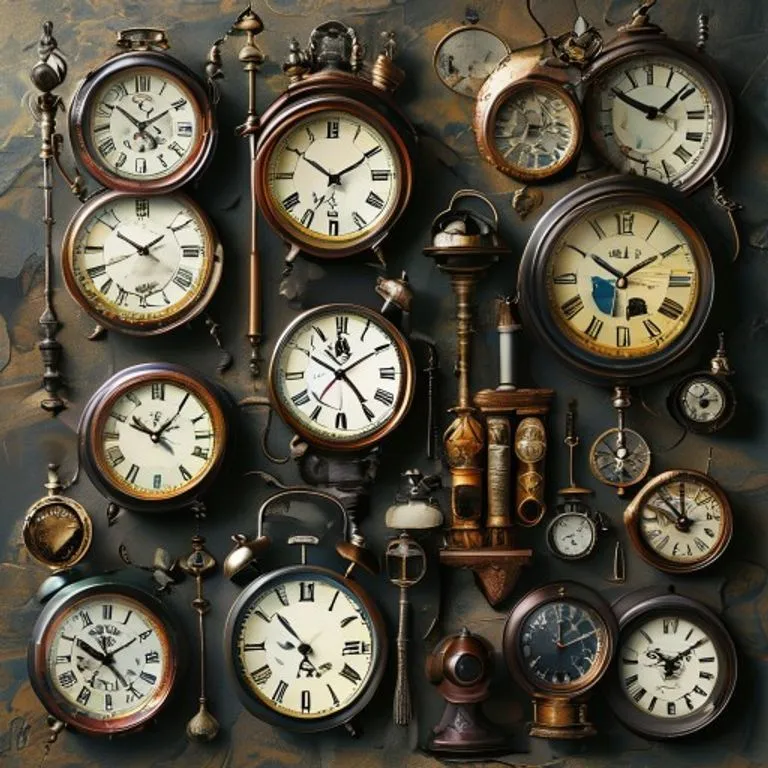
Brief description
A general category of instruments designed to measure, keep, and indicate time. From observing shadows to complex mechanics, timekeeping is essential for agriculture, navigation, and social coordination.
Use / Function
- Measurement: Tracking the duration of events.
- Coordination: Synchronizing activities across society (work, prayer, meetings).
- Navigation: Determining longitude at sea (requires high precision).
- Astronomy: Predicting celestial events.
Operating principle
All timepieces rely on a regular, repeatable process (oscillator) or a constant rate of change (flow).
- Observation: Using natural cycles (Sun, Moon, Stars).
- Flow: Using the steady movement of a substance (Water, Sand, Fire).
- Oscillation: Using a mechanical device that repeats a motion at a constant frequency (Pendulum, Balance Wheel, Quartz Crystal).
How to create it
The method depends on the required precision and available technology.
- Basic: Stick in the ground (Sundial).
- Intermediate: Dripping water vessel (Water Clock) or sand glass (Hourglass).
- Advanced: Gears and escapements (Pendulum Clock, Mechanical Watch).
Materials needed
- Natural: Stone, Wood, Sand, Water.
- Processed: Metal (Brass, Iron, Steel) for gears; Glass for protection and sand containers.
Variants and improvements
- Shadow Clocks: Sundial.
- Flow Clocks: Water Clock, Hourglass, Candle Clock.
- Mechanical Clocks: Pendulum Clock, Mechanical Watch, Chronometer.
- Modern: Quartz, Atomic (Cesium).
Limits and risks
- Accuracy: Early methods vary with weather (sun) or temperature (viscosity).
- Maintenance: Mechanical versions need winding, cleaning, and oiling.
- Fragility: Precision instruments are delicate.