Generated with AI3 min read
Mechanical Clocks
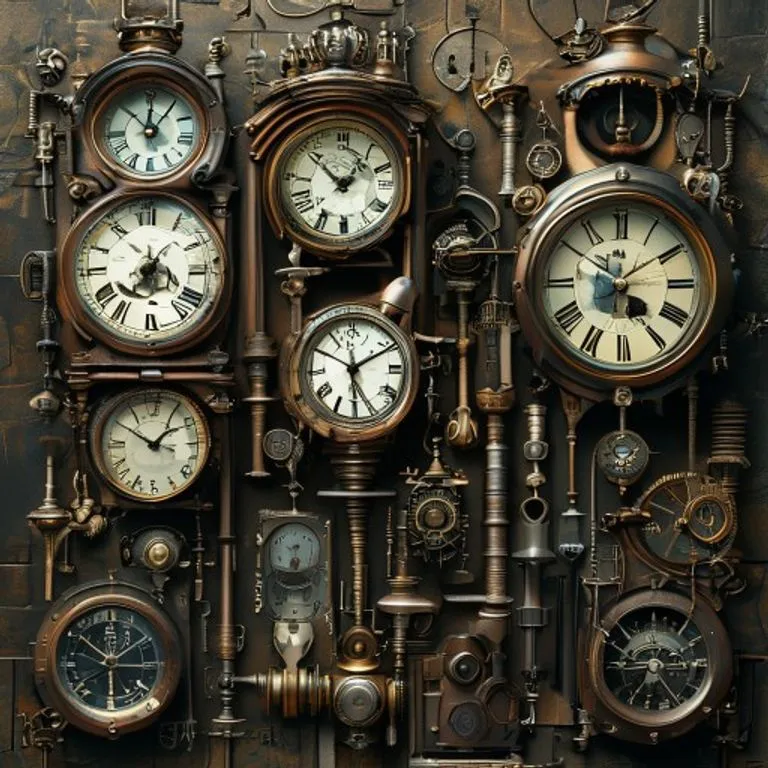
Brief description
A broad category of timekeeping devices that use a mechanical oscillator, such as a pendulum or balance wheel, regulated by an escapement mechanism to measure time with high precision. They marked a significant leap from flow-based (water, sand) or observation-based (sun) timekeeping methods.
Use / Function
- Precise Timekeeping: Measuring time with consistent accuracy regardless of weather or daylight.
- Public Time: Coordinating community activities through tower clocks.
- Navigation: Essential for determining longitude at sea (Chronometers).
- Scheduling: Standardizing work hours, transportation, and religious observances.
Operating principle
All mechanical clocks share four key components:
- Power Source: Stores potential energy to drive the clock. Usually a suspended weight (constant force) or a coiled spring (mainspring).
- Gear Train: A series of Gears that transmits energy from the power source to the escapement and counts the oscillations to drive the hands.
- Escapement: The “heart” of the clock. It blocks the gear train and allows it to advance one tooth at a time with each swing of the oscillator. This produces the characteristic “ticking” sound.
- Oscillator: A physical object that swings back and forth at a constant frequency (isochronism), such as a Pendulum or a Balance Wheel.
How to create it
Building a mechanical clock requires precision engineering and an understanding of mechanics.
- Frame: Construct a sturdy frame (plates and pillars) to hold the moving parts in precise alignment.
- Power System: Install the drum for the weight cord or the barrel for the mainspring.
- Transmission: Assemble the gear train. The ratios between gears must be calculated to convert the rapid beats of the escapement into seconds, minutes, and hours.
- Regulation: Fabricate the escapement wheel and the locking mechanism (verge, anchor, or lever). Connect this to the oscillator.
- Indication: Attach the hands to the appropriate arbors (shafts) of the gear train.
Materials needed
- Essential: Metal (Brass for gears to reduce friction, Steel for pinions and springs) is preferred. Hard Wood can be used for large tower clocks or rustic movements.
- Weights: Lead, Iron, or Stone.
- Lubrication: Fine Oil (historically from animal fat or plants) is crucial to prevent wear.
Variants and improvements
- Verge and Foliot: The earliest mechanical escapement, less accurate.
- Pendulum Clock: Uses a swinging weight for high accuracy (Pendulum Clock).
- Balance Wheel: Uses a spring-regulated wheel, allowing portability (Mechanical Watch).
- Striking Clocks: Mechanisms that sound bells at specific intervals.
Limits and risks
- Friction: The enemy of precision. Poorly finished parts or lack of oil will stop the clock.
- Temperature: Thermal expansion of metal parts can speed up or slow down the clock.
- Complexity: Requires specialized tools and high skill to manufacture.
- Maintenance: Must be wound regularly and cleaned periodically.