Generated with AI3 min read
Balance Wheel
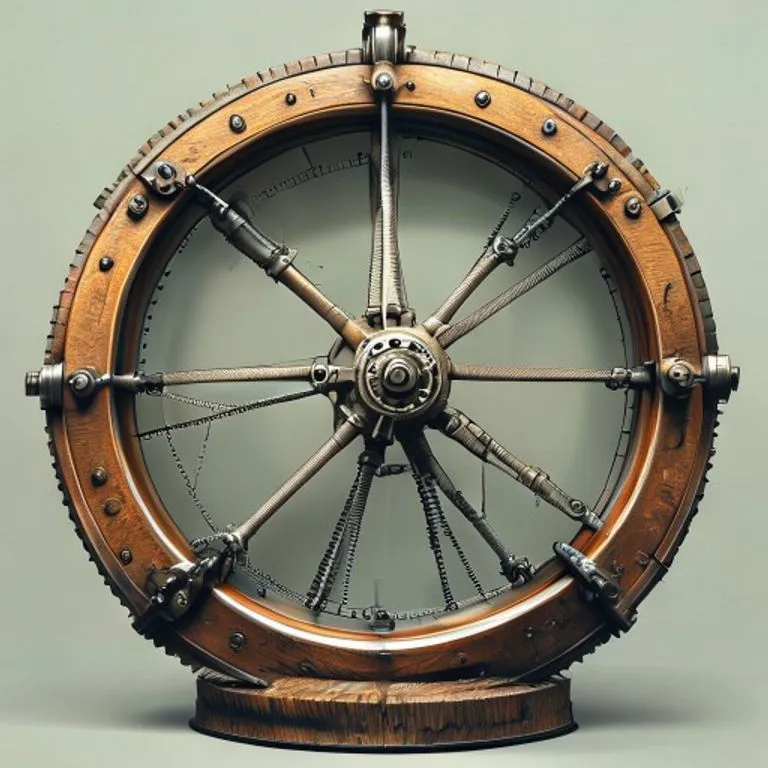
Brief description
The balance wheel is the timekeeping element used in portable mechanical timepieces, such as watches and marine chronometers. It acts as a harmonic oscillator, swinging back and forth, analogous to a pendulum in a stationary clock.
Use / Function
- Portable Timekeeping: Allows clocks to function correctly while moving, tilted, or being carried (unlike pendulums which require a fixed, level position).
- Regulation: Determines the accuracy of the watch by oscillating at a constant frequency.
Operating principle
The balance wheel works in conjunction with a hairspring (balance spring).
- Oscillation: The wheel rotates in one direction, winding the hairspring.
- Restoring Force: The tension in the spring stops the wheel and pushes it back in the opposite direction.
- Inertia: The wheel’s momentum carries it past the resting point, winding the spring in the other direction.
- Isochronism: Ideally, the time it takes to complete one swing is constant, regardless of how far it swings (amplitude).
How to create it
- Wheel: Fabricate a lightweight, perfectly balanced wheel. The rim is often heavier to increase inertia.
- Hairspring: Coil a very fine strip of spring steel or bronze into a spiral. Attach the inner end to the wheel’s axis (collet) and the outer end to a fixed stud.
- Poising: Test the wheel on knife-edges. Remove material from heavy spots to ensure gravity does not affect its rate when the watch is in different positions.
Materials needed
- Wheel: Brass or Steel.
- Hairspring: Spring Steel, Phosphor Bronze, or specialized alloys resistant to temperature changes.
- Pivots: Hardened Steel running in Ruby bearings.
Variants and improvements
- Bimetallic Balance: The rim is made of two metals (brass and steel) fused together. It curls as temperature changes to compensate for the hairspring’s changing elasticity.
- Glucydur Balance: Made of a beryllium-bronze alloy that is hard, non-magnetic, and stable.
- Free Sprung Balance: Regulated by adjusting inertia weights on the rim rather than changing the effective length of the spring.
Limits and risks
- Temperature: Heat makes the spring softer and the wheel larger, slowing the watch. Compensation is required for high accuracy.
- Magnetism: Steel hairsprings can become magnetized, causing the coils to stick together and the watch to run wildly fast.
- Shock: The pivots are extremely thin (like a hair) and can break if dropped. Shock protection systems (spring-loaded jewels) are needed.
Related Inventions
- Mechanical Watch
- Chronometer
- Escapement
- Spring Scale (concept of springs)
- Spring