Generated with AI3 min read
Gears
Brief description
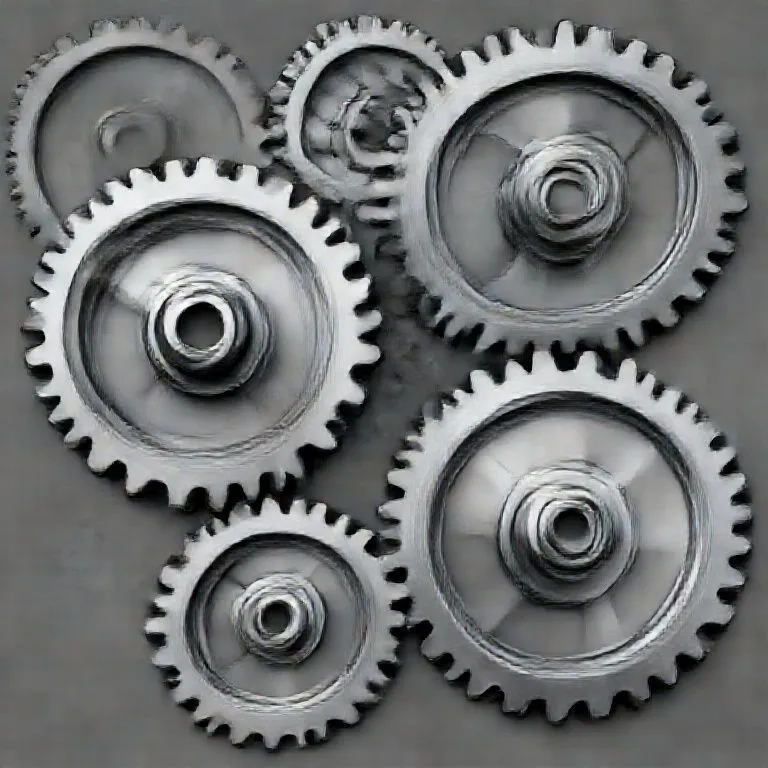
Gears are toothed wheels designed to mesh with one another to transmit motion and force between two shafts. They allow for the change of speed, torque, and direction of a power source.
Use / Function
- Speed Conversion: Increasing or decreasing the rotational speed of a mechanism.
- Torque Multiplication: Trading speed for force, essential for heavy lifting, Rolling Mills, or grain milling.
- Direction Change: Transmitting power around corners or reversing rotation (e.g., to make two rolls spin in opposite directions).
- Precision Timing: Used in clocks and instruments to maintain exact ratios of movement.
- Fluid Pumping: Used in Gear Pumps to move viscous liquids.
Operating principle
Gears work on the principle of mechanical advantage. When two gears mesh, the teeth of the driving gear push against the teeth of the driven gear. The ratio of the number of teeth between the two gears determines the change in speed and torque. For example, a small gear driving a larger gear will result in slower rotation but higher torque.
How to create it
- Blank Preparation: Create a circular disc (the blank) of uniform thickness.
- Indexing: Divide the circumference of the disc into an equal number of divisions corresponding to the desired number of teeth.
- Tooth Shaping: Cut or carve teeth into the edge of the disc. In primitive versions, this can be done by inserting sturdy wooden pegs into the rim.
- Profile Refinement: For smooth operation, the teeth should have a specific curved profile (like an involute curve) to ensure they roll against each other rather than slide.
- Mounting: Secure the gear to a shaft using a key, pin, or tight fit, ensuring it is perfectly centered.
Materials needed
- Gear Body: Hardwood (for primitive gears), Bronze, Iron, or Steel (for high-strength applications).
- Shaft: Metal or strong wood to support the gears.
- Lubricant: Animal fat, vegetable oil, or grease to reduce friction and wear.
- Cutting Tools: Saws, chisels, or specialized milling cutters.
Variants and improvements
- Spur Gears: The simplest type, with teeth parallel to the axis.
- Bevel Gears: Conical gears used to transmit power between intersecting shafts (usually at 90 degrees).
- Worm Gears: A screw-like gear that meshes with a wheel, allowing for very high reduction ratios and self-locking.
- Rack and Pinion: Converts rotational motion into linear motion.
Limits and risks
- Friction and Heat: Without proper lubrication, gears will wear down quickly and generate excessive heat.
- Alignment: Misaligned gears will cause noise, vibration, and premature failure.
- Breakage: Excessive load can snap teeth, especially in wooden or cast iron gears.
- Safety: Exposed moving gears are extremely dangerous and can cause severe injury if clothing or limbs get caught.