Generated with AI3 min read
Lens Grinding
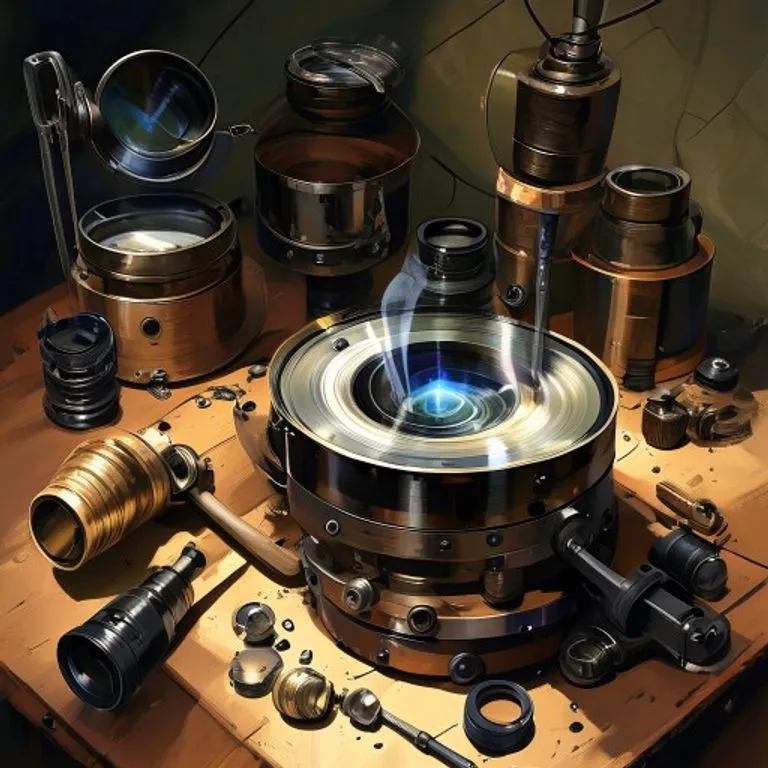
Brief description
Lens grinding is the precise mechanical process of shaping a transparent material (usually Glass or Quartz) into a curved surface to refract light. It transforms a rough blank into a precision optical component for instruments like Telescopes and Microscopes.
Use / Function
- Optical Components: Creating convex (converging) and concave (diverging) lenses.
- Precision Surface: Smoothing flat surfaces for mirrors or prisms.
- Correction: Adjusting the focal length of existing lenses.
Operating principle
The process relies on controlled abrasion. Hard, sharp particles (abrasives) are rubbed between the lens blank and a tool (lap).
- Grinding: Coarse abrasives remove material quickly to shape the curve.
- Smoothing: Finer abrasives remove the deep pits left by the coarse ones.
- Polishing: Extremely fine particles in a soft matrix (pitch) shave off the microscopic peaks, leaving a transparent surface.
How to create it
The method described is for a standard spherical lens.
- Preparation: Cut a Glass or Quartz disk (the blank). Prepare a “tool” of the same size (another glass disk or an iron disk).
- Rough Grinding (Hogging):
- Place coarse Sand (or emery) and water between the blank and the tool.
- Rub them together. To make a concave curve (hollow), place the blank on top and stroke center-over-center. To make convex, place the blank on the bottom.
- The abrasive breaks down and cuts the glass. Replenish often.
- Fine Grinding:
- Once the curve depth (sagitta) is reached, switch to finer sand.
- Wash everything thoroughly to remove every coarse grain. A single coarse grain will scratch the glass and ruin the work.
- Repeat with successively finer grades until the surface is smooth and frosted/opaque.
- Polishing:
- Cover the tool with hot Pitch (or beeswax/rosin mix) and press the lens onto it to shape the pitch.
- Use a slurry of water and Rouge (Iron Oxide/Rust) or Tripoli.
- Rub the lens on the pitch lap for hours. The pitch holds the fine particles, which plane the glass surface until it becomes transparent.
Technical Level: Advanced. Requires extreme cleanliness and patience.
Materials needed
- Essential:
- Blank: Glass or Quartz.
- Tool: Another piece of glass, Iron, or Brass.
- Abrasives: Sand (sifted to different sizes), Emery (Corundum), Crushed Garnet.
- Polishing Agent: Rouge (Iron Oxide/Rust), Tripoli (rottenstone), or wood ash (less effective).
- Lap Base: Pitch, Beeswax, or Felt/Leather (for lower quality).
- Lubricant: Water.
Variants and improvements
- Lathe Grinding: Mounting the tool on a spinning Lathe allows for faster, more even grinding.
- Fixed Post: Walking around a barrel (post) while grinding helps randomize the stroke and keep the curve spherical.
- Templates: Metal gauges cut to the specific radius to check progress.
Limits and risks
- Scratches: Inadequate cleaning between grit stages causes deep scratches that require restarting from the coarse stage.
- Astigmatism: Irregular pressure or strokes create a non-spherical (football-shaped) curve, distorting the image.
- Silicosis: Grinding creates fine glass/silica dust. Always grind wet to prevent inhaling the dust.
- Thermal Shock: Friction generates heat; the glass can crack if it gets too hot or cools too fast.