Generated with AI3 min read
Microscope
Brief description
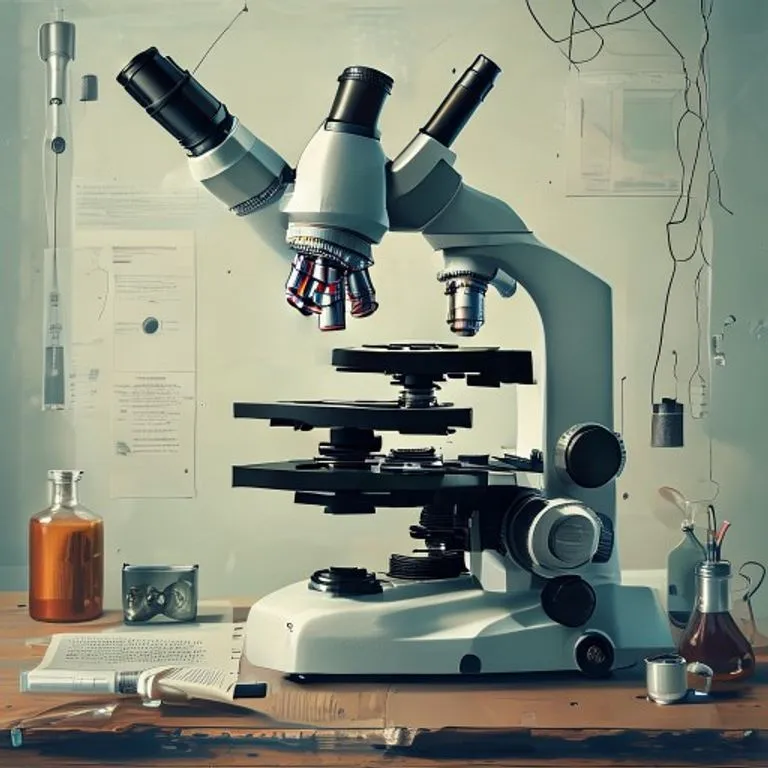
A microscope is an optical instrument that uses one or more lenses to magnify minute objects that are invisible to the naked eye, such as cells, bacteria, and crystal structures.
Use / Function
- Scientific Observation: Viewing the microscopic world (biology, medicine).
- Diagnosis: Identifying parasites and pathogens in blood or water.
- Material Analysis: Inspecting the structure of metals, crystals, and fibers.
- Quality Control: Examining precision parts for defects.
Operating principle
It uses refraction through a system of lenses:
- Objective Lens: A very strong convex lens placed close to the object. It creates a magnified “real image” inside the tube.
- Eyepiece (Ocular): Another convex lens that acts as a magnifying glass, further enlarging the image created by the objective lens for the eye.
- Illumination: Light is focused through the sample (often using a mirror or condenser lens) to make it visible.
How to create it
- Lens Fabrication: Create two high-quality convex lenses. The objective lens must have a very short focal length (very curved). The eyepiece can be a standard magnifier.
- Tube Construction: Mount the lenses at opposite ends of a light-tight tube. The distance between them must be adjustable to focus.
- Stand and Stage: Build a stable stand to hold the tube. Add a flat stage to hold the sample.
- Lighting: Place a small adjustable mirror below the stage to reflect light up through the sample.
Technical Level: Advanced. Requires high-precision lenses and a stable mechanical structure.
Materials needed
- Essential: High-quality Lenses (glass or quartz).
- Structure: Metal (Brass, iron) or fine wood for the tube and stand.
- Tools: Lathe, glass grinding tools, drills.
- Substitutes: A single tiny glass bead (van Leeuwenhoek style) can act as a powerful single-lens microscope if mounted in a small metal plate.
Related Inventions
Related Materials
Variants and improvements
- Simple Microscope: A single high-power lens (like van Leeuwenhoek’s). Hard to use but effective.
- Compound Microscope: Two or more lenses (Objective + Eyepiece). Easier to use and higher magnification.
- Electron Microscope: Uses electron beams instead of light (modern, high-tech).
Limits and risks
- Resolution Limit: Optical microscopes are limited by the wavelength of light (approx. 0.2 micrometers).
- Lighting: Requires bright light; too much heat from the light source can damage the sample.
- Depth of Field: Only a very thin slice of the object is in focus at one time.