Generated with AI2 min read
Telescope
Brief description
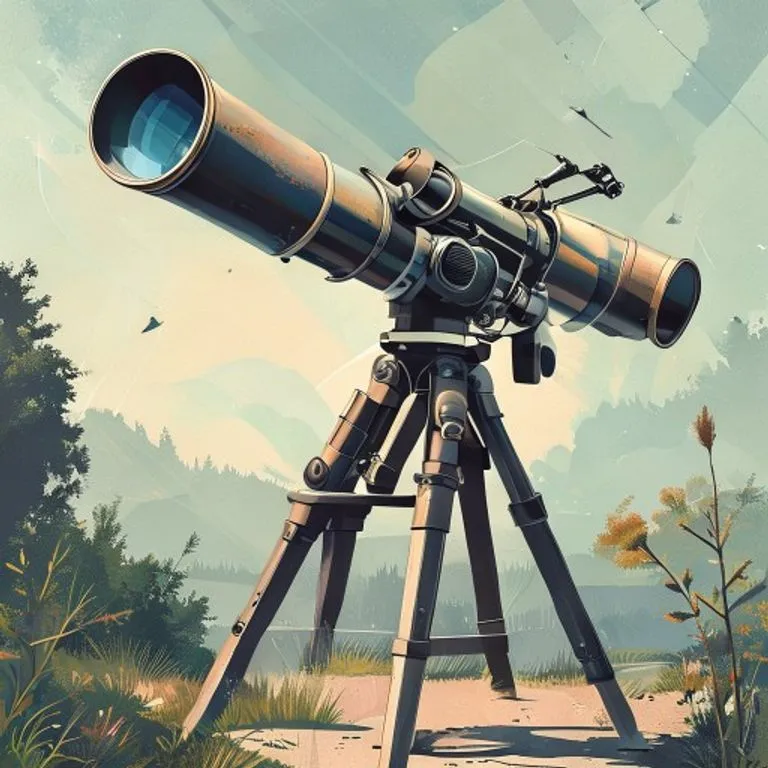
A telescope is an optical instrument that makes distant objects appear magnified by using an arrangement of lenses or curved mirrors and lenses. It is essential for astronomy and long-distance observation (terrestrial or maritime).
Use / Function
- Astronomy: Observing celestial bodies (moon, planets, stars).
- Navigation: Spotting land or ships at sea from a great distance.
- Surveillance: Observing distant locations or activities.
Related Inventions
Related Materials
Operating principle
It collects light from a distant object and focuses it to a point.
- Objective (Lens or Mirror): A large lens (refractor) or concave mirror (reflector) gathers a lot of light and focuses it to a small point inside the tube. The larger the objective, the brighter and clearer the image.
- Eyepiece: A small lens that magnifies the focused image for the eye.
How to create it
Refracting Telescope (Galilean/Keplerian):
- Objective Lens: Create a large convex lens with a long focal length (e.g., 1 meter). This should be weak magnification but large diameter.
- Eyepiece Lens: Create a small convex lens (Keplerian) or concave lens (Galilean) with a short focal length.
- Tube: Mount the lenses in a tube. The distance between them should be the sum of their focal lengths (for Keplerian).
- Focus: Make one part of the tube slide inside the other to adjust the focus.
Technical Level: Advanced. The difficulty lies in grinding the large objective lens accurately.
Materials needed
- Essential: High-quality Lenses.
- Tube: Wood, stiff cardboard, metal (Brass).
- Black Paint: To coat the inside of the tube and prevent stray light reflections.
Variants and improvements
- Galilean: Uses a concave eyepiece. Upright image but narrow field of view. Low magnification.
- Keplerian: Uses a convex eyepiece. Inverted image but wider field of view. High magnification.
- Reflector (Newtonian): Uses a concave mirror instead of a large lens. Easier to make large apertures and no chromatic aberration.
Limits and risks
- Atmospheric Turbulence: Heat waves in the air distort the image (shimmering).
- Light Pollution: Artificial lights make it hard to see faint stars.
- Sun Damage: NEVER look at the sun through a telescope without a special solar filter. It will instantly blind you.