Lathe
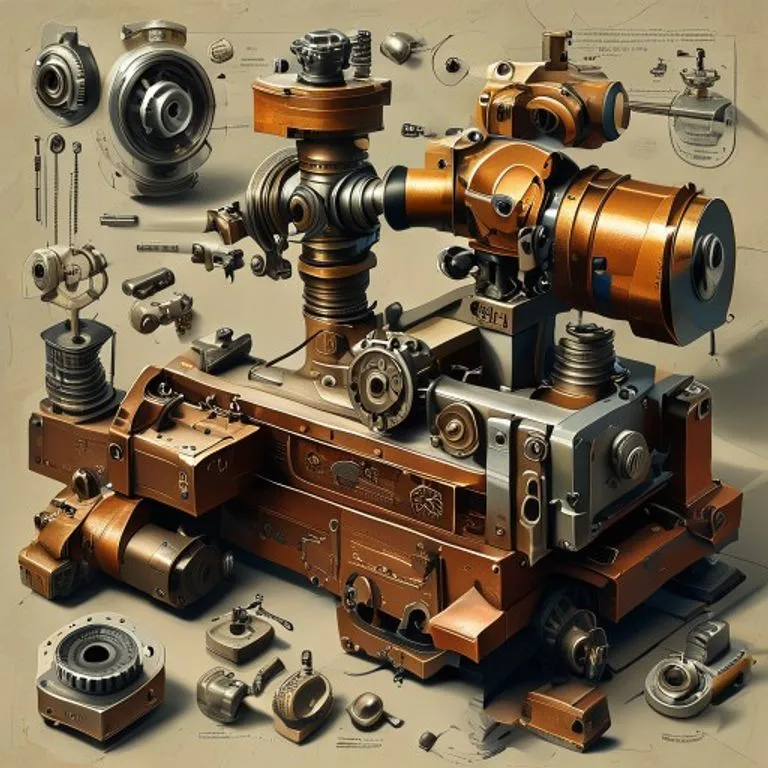
Brief description
A lathe is a machine tool that rotates a workpiece about an axis of rotation to perform various operations such as cutting, sanding, knurling, drilling, deformation, facing, and turning, with tools that are applied to the workpiece to create an object with symmetry about that axis. It is known as the “Mother of Machine Tools” because it was the first machine tool that led to the invention of other machine tools.
Use / Function
- Primary Use: Turning cylindrical parts (shafts, pins, pulleys).
- Secondary Uses: Thread cutting (screws), facing (flat ends), drilling (center holes), knurling (grips).
- Scale: Industrial/Workshop.
Operating principle
The workpiece is held in a chuck or collet (on the headstock) and rotated at high speed. A Lathe Tool, mounted on a carriage that moves along the bed (Z-axis) and cross-slide (X-axis), is fed into the rotating workpiece to remove material in the form of continuous chips.
How to create it
Minimum functional version (Metal Lathe)
- Bed: Two parallel, precision-ground rails (ways) made of cast iron or heavy steel.
- Headstock: Contains the main spindle and drive mechanism (pulleys/gears). It must be perfectly aligned with the bed.
- Tailstock: Slides along the bed to support long workpieces or hold drill bits.
- Carriage: Moves along the bed and holds the tool post.
- Lead Screw: A long precision screw that drives the carriage for automatic feed and thread cutting.
Materials needed
- Essential:
- Cast Iron: For the bed, headstock, and carriage (vibration damping is critical).
- Hardened Steel: For the spindle, ways, and lead screw. Cutting tools (Lathe Tools) are often made of High Speed Steel or Carbide.
- Bronze: For bearings and the lead screw nut.
- Tools: Scraper (for hand-scraping ways to precision), Drill Press, Files.
Variants and improvements
- Manual Lathe: Woodworking or simple metal spinning lathe without a carriage.
- Engine Lathe: The standard metalworking lathe with a lead screw for threading.
- Turret Lathe: Has a rotating turret with multiple tools for mass production.
- CNC Lathe: Computer-controlled for complex profiles and high precision.
Relationship with Mills and Drills
The Lathe, the Milling Machine, and the Drill Press form the “Holy Trinity” or fundamental triad of machine tools.
- Lathe: Rotates the workpiece. Best for cylinders, screws, and round shapes.
- Mill/Drill: Rotates the tool. Best for flat surfaces, slots, and holes.
Together, they allow for the creation of almost any other machine, including the replication of themselves. You often need a lathe to make parts for a mill (like spindles), and a mill to make parts for a lathe (like the bed or carriage slots).
Limits and risks
- Safety: The rotating chuck is extremely dangerous. It can catch loose clothing or hair, causing severe injury or death. NEVER wear gloves or long sleeves while operating. Chuck keys must never be left in the chuck.
- Precision: Requires a rigid setup; vibrations (chatter) ruin the finish. Accuracy depends on the straightness of the bed and spindle bearings.
- Maintenance: Ways must be kept clean and oiled to prevent wear.