Generated with AI3 min read
Airplane
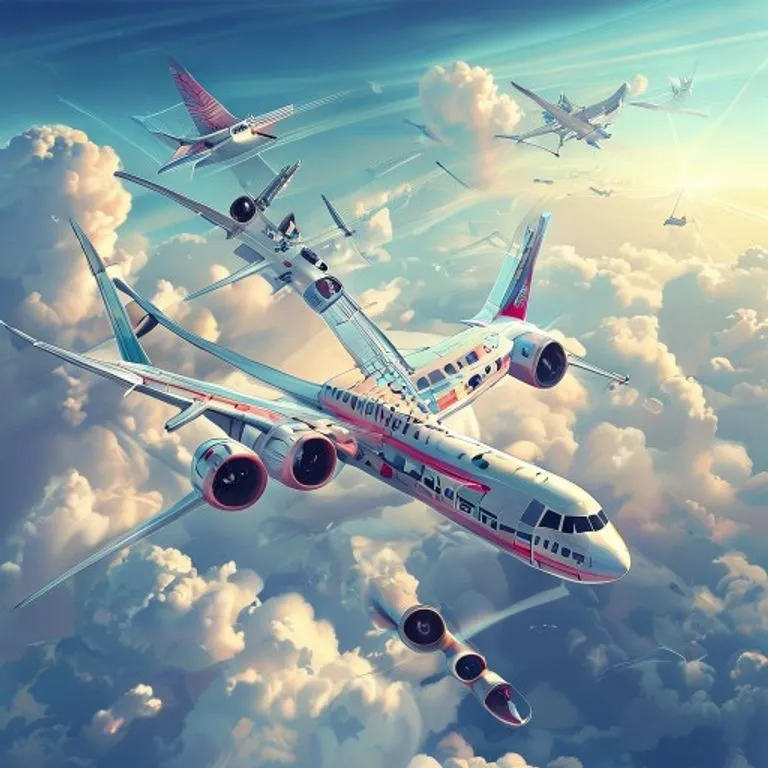
Brief description
An Airplane (or powered aircraft) is a heavier-than-air powered vehicle with fixed wings that generates lift through aerodynamic forces produced as it is propelled forward by an engine. It represents the realization of controlled, long-distance powered flight.
Use / Function
- Rapid Long-Distance Transport: Moving passengers, cargo, and critical supplies across continents and oceans.
- Aerial Reconnaissance and Mapping: Cartography, land surveying, and monitoring weather or environmental conditions.
- Emergency Medical Transport: Rapid evacuation of wounded or sick individuals from isolated areas.
- Agriculture: Crop dusting and large-scale pest control.
Operating principle
An airplane operates by balancing four dynamic forces in flight:
- Lift: Created by air flowing over curved wings (airfoils), generating lower pressure above the wing than below it (Bernoulli’s principle and Newton’s third law).
- Thrust: Mechanical force created by a Propeller or jet engine pushing air backward, driving the aircraft forward.
- Weight: Gravity pulling the aircraft downward toward Earth.
- Drag: Atmospheric resistance opposing forward movement through the air.
Three-axis flight control is maintained through movable surfaces:
- Ailerons on the wings for Roll (banking left or right).
- Elevators on the tail for Pitch (pointing the nose up or down).
- Rudder on the tail for Yaw (steering left or right).
How to create it
- Airframe Construction: Build a lightweight, rigid frame using spruce Wood or Aluminum tubing.
- Wing & Surface Fabrication: Shape airfoil ribs and attach them to wing spars. Cover with high-tensile Fabric (treated for air tightness) or light metal sheeting.
- Power Plant Integration: Mount a high power-to-weight Internal Combustion Engine connected to a wooden or metal Propeller.
- Control Mechanism Setup: Link control stick and rudder pedals to movable control surfaces using tensioned steel Wire cables and pulleys.
- Testing & Calibration: Conduct low-speed taxi runs and short glide hops to verify center of gravity and control response before sustained powered flight.
Technical Level: Advanced. Requires precise aerodynamics, reliable engines, and structural integrity.
Materials needed
- Essential:
- Power Unit:
- Internal Combustion Engine: Provides high thrust relative to engine weight.
- Propeller: Converts engine rotation into forward thrust.
- Tools: Lathe, drill press, woodworking tools, cable tensioners, welding/fastening equipment.
Variants and improvements
- Pioneer Biplane: Two stacked wings providing large surface area with lightweight wood and wire construction (e.g., Wright Flyer).
- Monoplane: Single wing configuration offering lower drag and higher aerodynamic efficiency.
- All-Metal Aircraft: Aluminum or duralumin stressed-skin fuselage for vastly higher speed, durability, and load capacity.
- Jet Aircraft: Replaces piston engine and propeller with gas turbine engines for high-altitude, high-speed flight.
Limits and risks
- Engine Failure: Loss of thrust requires emergency gliding to a suitable landing field.
- Stall & Spin: Flying below critical airspeed causes loss of lift, leading to rapid altitude loss or uncontrolled rotation.
- Weather Hazards: Severe turbulence, icing, and low visibility present extreme risks to aircraft stability and navigation.
- Fuel Limitations: Flight range is strictly bounded by engine efficiency and fuel capacity.