Generated with AI3 min read
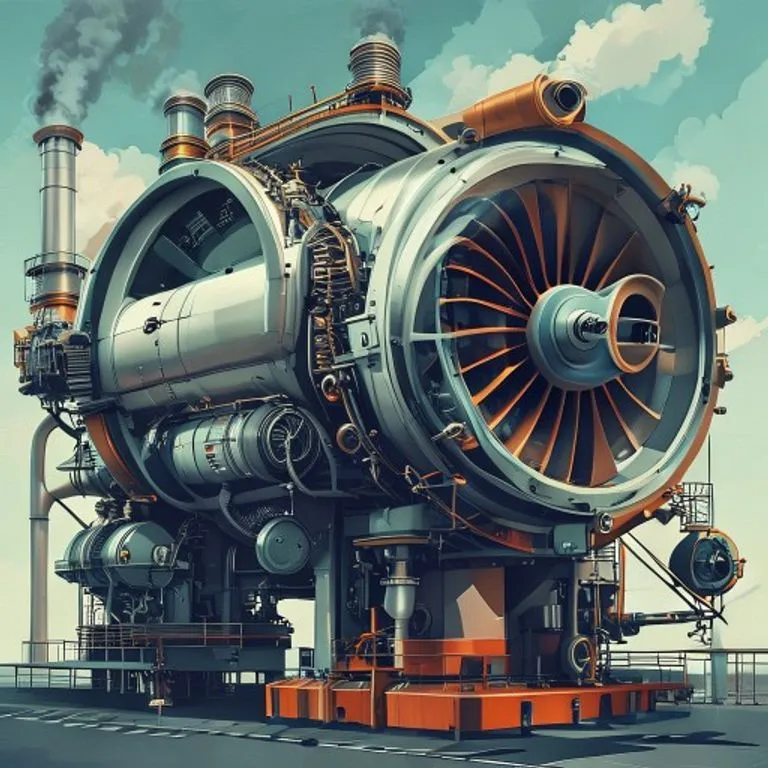
Gas Turbine
Brief description
A gas turbine (also called a combustion turbine) is a type of continuous-flow internal combustion engine. It converts the chemical energy of fuel into mechanical energy by using a stream of fast-moving combustion gases to rotate a turbine.
Use / Function
- Aviation: Powering jet aircraft (Turbojets, Turbofans).
- Power Generation: Driving large generators in power plants.
- Marine Propulsion: Powering fast ferries and naval ships.
- Industrial Drives: Powering large pumps and compressors.
- Scale: From small auxiliary power units (APUs) to massive 500+ megawatt turbines.
Operating principle
The gas turbine operates on the Brayton cycle, which involves three main stages in a continuous flow:
- Compression: A rotary compressor draws in atmospheric air and compresses it to high pressure.
- Combustion: The compressed air is mixed with fuel and ignited in a combustion chamber. This produces a high-velocity, high-temperature gas stream.
- Expansion: The hot gases expand through a turbine, forcing it to rotate.
- Some of this rotation powers the compressor (Step 1).
- The remaining energy (useful work) can drive a shaft (Turboshaft) or provide thrust by exhausting the gases at high speed (Turbojet).
How to create it
Building a gas turbine is extremely difficult because it requires materials that can withstand high centrifugal forces and intense heat simultaneously:
- Precision Blades: Turbine blades must be aerodynamically perfect and capable of operating at temperatures near their melting point.
- High-Speed Bearings: Must support shafts rotating at tens of thousands of RPM.
- Advanced Metallurgy: Requires specialized alloys (Superalloys) that maintain strength at red-hot temperatures.
- Technical level: Extremely Advanced.
Materials needed
- Essential materials:
- Superalloys: Specialized Steel or nickel-based alloys for turbine blades.
- Stainless Steel: For the housing and combustion chambers.
- Aluminum: For the compressor sections (cooler parts).
- Copper: For sensors and control systems.
- Tools:
- Precision Lathe: For machining rotating parts.
- Casting Equipment: For investment casting of blades.
Variants and improvements
- Turbojet: Pure jet engine where all energy comes from exhaust thrust.
- Turbofan: A large fan at the front provides most of the thrust; much more efficient and quieter.
- Turboprop: Uses the turbine to drive a propeller.
- Combined Cycle: Using the hot exhaust from a gas turbine to boil water for a Steam Turbine, greatly increasing efficiency.
Limits and risks
- Fuel Consumption: Can be very high, especially at low speeds or partial loads.
- Heat Stress: Components eventually fail due to “creep” (stretching under heat and stress).
- Foreign Object Damage (FOD): Inhaling a bird or stone can destroy the engine instantly.
- Noise: Extremely loud without specialized suppression.
Related Inventions
- Steam Turbine: Shares the turbine principle but uses steam.
- Internal Combustion Engine: The broader family of heat engines.