Generated with AI3 min read
Internal Combustion Engine
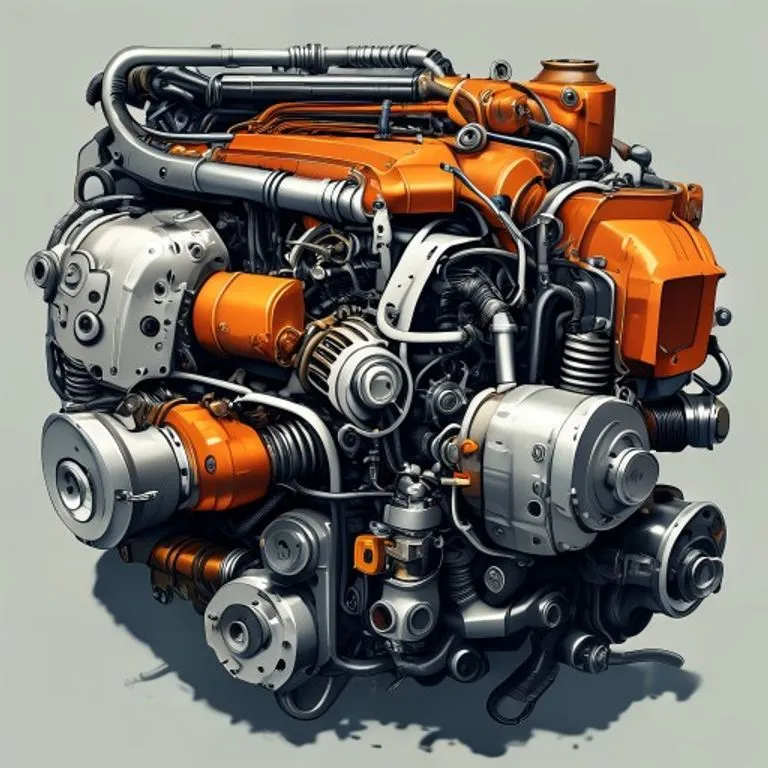
Brief description
An internal combustion engine (ICE) is a heat engine in which the combustion of a fuel occurs with an oxidizer (usually air) in a combustion chamber that is an integral part of the working fluid flow circuit. The expansion of the high-temperature and high-pressure gases produced by combustion applies direct force to some component of the engine, such as pistons.
Use / Function
- Primary use: Powering vehicles (cars, motorcycles, trucks, boats, and small aircraft).
- Secondary uses: Portable power generators, industrial machinery, and lawnmowers.
- Scale: From small model engines to massive marine engines powering container ships.
Operating principle
Most common is the four-stroke cycle:
- Intake: The Piston moves down, and the intake Valve opens to pull in a mixture of air and fuel.
- Compression: The valves close, and the piston moves up, compressing the mixture.
- Power: A spark ignites the mixture, causing an explosion that forces the piston back down.
- Exhaust: The exhaust valve opens, and the piston moves up to push out the waste gases.
This linear motion is converted into rotation via a crankshaft.
How to create it
Building a functional ICE requires high precision and advanced metallurgy:
- Cylinder Block: Cast from Iron or Aluminum, then bored and honed to a very smooth finish.
- Pistons and Rings: Must fit tightly to maintain compression but move freely.
- Valves and Camshaft: Precisely timed to open and close at the right moments.
- Ignition System: Requires a way to time a spark (magneto or battery/coil system).
- Fuel System: A carburetor to mix fuel with air in the correct ratio.
- Tires: Modern vehicles require Pneumatic Tires for traction and comfort at speed.
Materials needed
- Block and Head: Iron (durable) or Aluminum (lightweight).
- Crankshaft and Connecting Rods: Forged Steel.
- Pistons: Aluminum alloys.
- Bearings: Bronze or specialized soft metal alloys.
- Fuel: Gasoline or diesel derived from Crude Oil, or biofuels (alcohol).
Variants and improvements
- Two-stroke Engine: Simpler, lighter, but less efficient and more polluting.
- Diesel Engine: Uses compression ignition instead of a spark; more efficient.
- Turbocharging: Uses exhaust gases to pump more air into the engine for more power.
- Wood Gasifier: A device that allows an ICE to run on solid wood or charcoal fuel by converting it into combustible gas.
Limits and risks
- Heat: Requires a cooling system (water or air) to prevent the metal from melting or seizing.
- Lubrication: Requires constant oil flow to reduce friction and wear.
- Emissions: Produces CO2, NOx, and particulate matter.
- Complexity: Requires very high manufacturing tolerances; a small failure can destroy the entire engine.