Generated with AI3 min read
Propeller
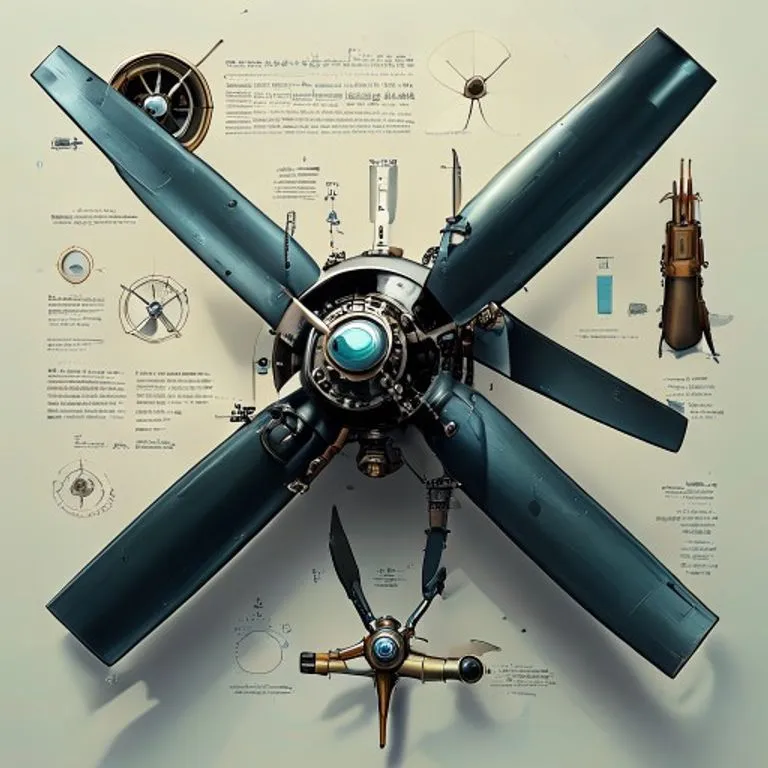
Brief description
A Propeller is a device with a central hub and radiating blades set at a pitch, forming a helical surface. When rotated, it acts like a screw in a fluid (air or water), creating a pressure difference between the front and rear surfaces, which generates thrust to push or pull a vehicle.
Use / Function
- Marine Propulsion: Driving ships, boats, and submarines through water.
- Aviation: Generating thrust for airplanes and lift for helicopters (rotors).
- Fans: Moving air for cooling or ventilation.
- Energy Generation: In reverse, it acts as a turbine (wind or water) to extract energy from a fluid flow.
Operating principle
The propeller works based on Bernoulli’s principle and Newton’s third law:
- Rotation: An engine or motor rotates the propeller hub.
- Angle of Attack: The blades are set at an angle (pitch) so that they “bite” into the fluid.
- Pressure Difference: As the blade moves, it creates lower pressure on one side and higher pressure on the other (lift/thrust).
- Momentum Exchange: The propeller accelerates a mass of fluid in one direction, creating an equal and opposite force (thrust) on the propeller and the vehicle it is attached to.
How to create it
- Level: Intermediate to Advanced.
- Design: The blades must have an airfoil or hydrofoil cross-section. The pitch (angle) should ideally decrease from the hub to the tip to ensure even thrust.
- Shaping: Can be carved from Wood, cast from Bronze or Aluminum, or forged from Steel.
- Balancing: It is critical that the propeller is perfectly balanced; otherwise, the vibration at high speeds will destroy the engine bearings.
Materials needed
- Wood: Good for early aircraft propellers; easy to carve but prone to weathering and splitting.
- Bronze: Excellent for marine use due to its corrosion resistance.
- Aluminum: Lightweight and strong, standard for modern aircraft.
- Steel: Used for large, heavy-duty marine propellers.
- Tools: Adze or Hand Plane for wood, or foundry equipment for metal.
Variants and improvements
- Fixed-Pitch: The simplest type, optimized for one specific speed.
- Variable-Pitch: Allows the angle of the blades to be changed during operation to maintain efficiency at different speeds.
- Contra-rotating: Two propellers on the same axis rotating in opposite directions to cancel torque and increase efficiency.
- Ducted Propeller (Kort nozzle): A propeller inside a shroud to increase efficiency at low speeds.
Limits and risks
- Cavitation (Water): At high speeds, low pressure on the blade back can cause water to boil, creating bubbles that collapse and damage the metal.
- Vibration: Improper balance or damage to a blade causes severe mechanical stress.
- Safety: Rotating blades are extremely dangerous to anything nearby.