Generated with AI3 min read
Crossbow
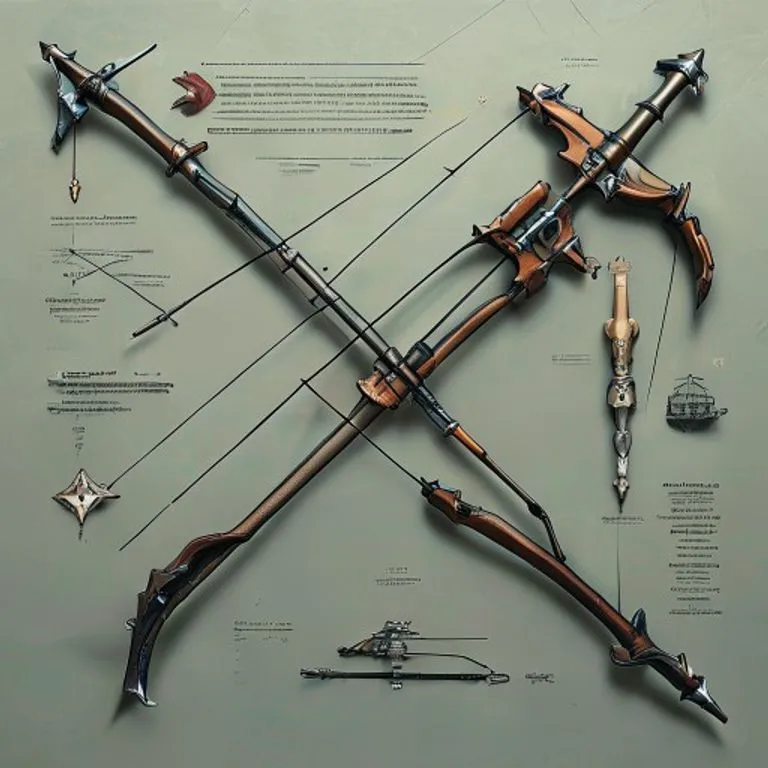
Brief description
A crossbow is a ranged weapon that consists of a bow-like assembly called a prod, mounted horizontally on a main frame called a tiller. It uses a trigger mechanism to hold the drawn string and release it to fire a bolt or quarrel. It allows for greater power and precision than a standard bow with less training.
Use / Function
- Hunting: Precise shooting of game at a distance.
- Defense: Effective for defending fortifications due to its ability to be kept cocked.
- Armour penetration: Powerful versions can penetrate heavy leather or even some metal armours.
- Ease of use: Requires significantly less physical strength and training time than a longbow.
Operating principle
The crossbow stores mechanical potential energy in the limbs of the prod when the string is pulled back (drawn). Unlike a regular bow, this energy is held by a mechanical nut or sear.
- Drawing: The string is pulled back manually or with a mechanical aid (like a winch or stirrup).
- Locking: The string is caught by a trigger mechanism.
- Loading: A bolt is placed in a groove on the tiller.
- Firing: Pressing the trigger releases the nut, allowing the string to snap forward and transfer the stored energy to the bolt.
How to create it
Minimum functional version
- The Tiller: A sturdy piece of hardwood carved with a groove for the bolt and a slot for the trigger mechanism.
- The Prod: A flexible but strong limb made of wood (yew or ash), composite (wood, horn, and sinew), or steel.
- The Trigger: A simple “rolling nut” or a lever-based sear that holds the string.
- Assembly: The prod is lashed securely to the front of the tiller using heavy cord or iron brackets.
Required technological level
Intermediate. Requires good woodworking and basic metallurgy or complex composite construction.
Materials needed
- Essential: Strong hardwood (for the tiller), springy wood or steel (for the prod), strong cord (linen or hemp for the string).
- Tools: Saw, Chisel, Knife, Drill.
- Substitutes: Bamboo for the prod, leather strips for lashing, bone or antler for the nut.
Variants and improvements
- Gastraphetes: An early Greek “belly-bow” cocked by leaning into it.
- Repeating Crossbow: A Chinese design with a magazine and lever for rapid fire.
- Arbalest: A large, heavy crossbow with a steel prod, requiring a Winch to cock.
Limits and risks
- Slow reload: Much slower to fire than a traditional bow.
- Mechanical failure: The trigger or prod can snap under high tension, causing injury.
- Weight: Heavier and more cumbersome to carry than a regular bow.
- String maintenance: The string is under constant high stress and must be kept dry and waxed.