Generated with AI3 min read
Winch
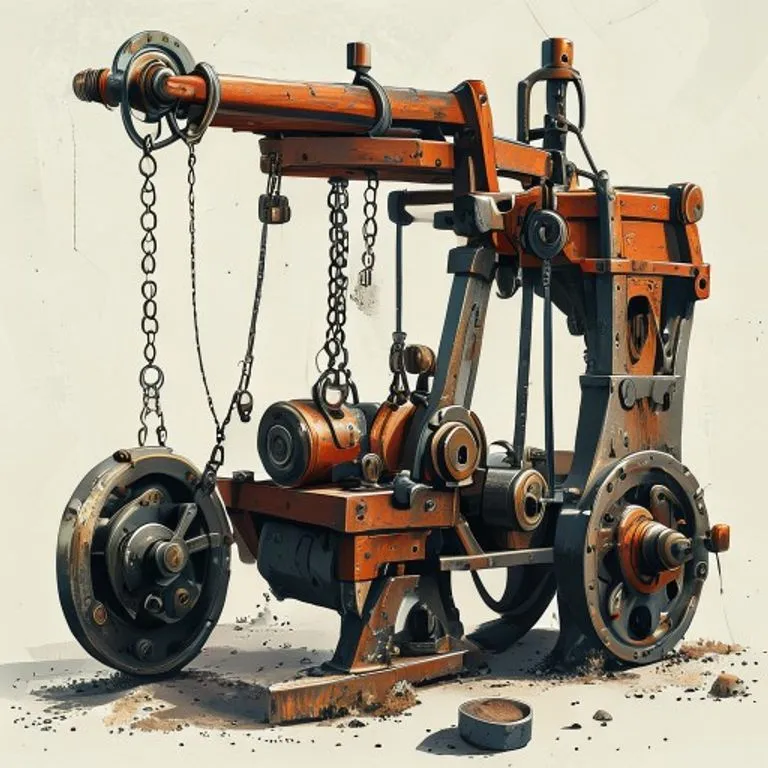
Brief description
A winch is a mechanical device that is used to pull in (wind up) or let out (wind out) or otherwise adjust the tension of a rope or wire rope (also called “cable” or “wire cable”). In its simplest form, it consists of a spool (or drum) attached to a hand crank.
Use / Function
- Lifting: Raising heavy loads vertically (e.g., drawing water from a well, lifting construction materials).
- Towing: Pulling vehicles or heavy objects horizontally.
- Tensioning: Tightening ropes or cables on boats or structures.
- Anchoring: Holding a position against a strong force.
Operating principle
The winch operates on the principle of the wheel and axle. By rotating a handle (which traces a large circle), the user turns a smaller drum. This creates mechanical advantage, allowing a small force applied over a long distance to exert a large force over a short distance.
- Torque: The crank arm acts as a lever to apply torque to the drum.
- Friction: The friction between the rope and the drum holds the load.
- Ratchet: A ratchet mechanism often prevents the drum from unwinding under load.
How to create it
- Frame: Build a sturdy frame to hold the drum and axle.
- Drum: Create a cylindrical drum (spool) from wood or metal. It needs flanges on the ends to keep the rope from sliding off.
- Axle: Insert an axle through the center of the drum and the frame.
- Crank: Attach a crank handle to the axle.
- Rope: Secure one end of the rope to the drum.
- Locking Mechanism: Install a ratchet and pawl or a simple locking pin to prevent the drum from spinning backwards when you let go of the handle.
Materials needed
- Frame/Drum: Hardwood or metal.
- Axle/Crank: Iron or steel rod.
- Rope: Strong hemp rope or steel cable.
- Fasteners: Nails, bolts, or joinery to hold the frame together.
Variants and improvements
- Windlass: A horizontal winch used on ships to raise anchors.
- Capstan: A vertical-axis winch, often used on sailing ships.
- Geared Winch: Uses gears to further increase mechanical advantage.
- Electric/Hydraulic Winch: Powered by motors for much higher capacity and ease of use.
Limits and risks
- Cable Snap: If the cable breaks under tension, it can whip back with deadly force.
- Freewheeling: If the handle slips or the lock fails, the load can cause the handle to spin rapidly, causing injury (“knuckle-busting”).
- Overheating: Continuous use can generate heat in the brake or gears.