Generated with AI3 min read
Hand Drill
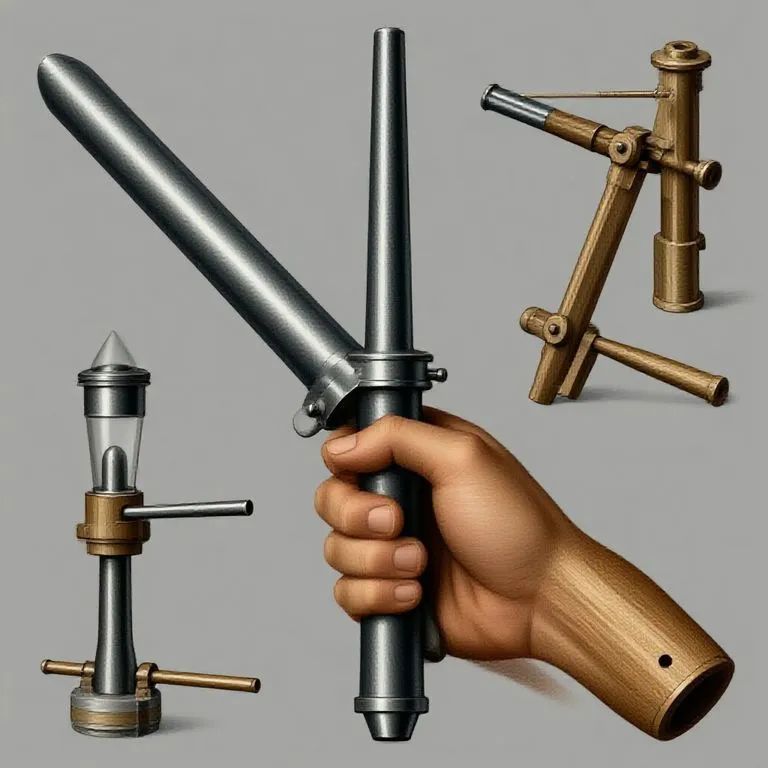
Brief description
A hand drill is a manually operated tool used for boring holes in various materials. It applies torque and axial force to a Drill Bit to cut into wood, metal, plastic, or stone.
Use / Function
Its primary function is to drill holes without the need for electricity.
- Primary use: Drilling holes for joinery (dowels, screws) or assembly.
- Secondary uses: Driving screws (if equipped with a screwdriver bit), mixing paint (with appropriate attachment).
- Scale: Individual/Workshop.
Operating principle
The hand drill converts manual linear or rotational motion into high-speed rotation of the chuck holding the bit.
- Brace (Berbiquí): Uses a crank handle. The user sweeps their arm in a circle. High torque, low speed. Good for large auger bits in wood.
- Geared Hand Drill (Eggbeater): Uses a hand crank connected to a large gear, which drives a smaller pinion gear attached to the chuck. This gears up the speed (e.g., 1 turn of the handle = 4 turns of the bit). High speed, lower torque. Good for small holes.
How to create it
Minimum functional version (Bow Drill)
A wooden spindle, a hearth board, a bearing block (wood/stone), and a bow with a string. Moving the bow back and forth rotates the spindle.
Intermediate version (Pump Drill)
A spindle with a flywheel (weight) and a crossbar with cords winding around the spindle. Pushing the crossbar down unwinds the cords, spinning the drill; the flywheel momentum rewinds the cords for the next stroke.
Advanced version (Bit Brace / Geared Drill)
Requires metalworking.
- Frame: Forged iron or steel rod bent into a crank shape (for a brace) or a cast frame (for geared drill).
- Gears: (For geared drill) Cut teeth into metal disks to create a gear train.
- Chuck: A mechanism (usually with 2 or 3 jaws) to securely hold the drill bit.
- Handles: Wood handles for the crank and the main grip, allowing free rotation.
Materials needed
- Essential materials:
- Wood: For handles, knobs, and primitive drill bodies.
- Metal (Iron/Steel): For the shaft, gears, chuck, and the bit itself.
- Tools: Forge, files, lathe (for precise gears/shafts), woodworking tools.
Variants and improvements
- Bow Drill: Primitive, slow, requires two hands (or one hand and mouth/chest).
- Brace: High torque, great for carpentry.
- Push Drill (Archimedes Screw): Pushing a handle down a spiraled shaft causes rotation. Very fast for small holes.
- Breast Drill: A larger geared drill with a plate to lean against with the chest, allowing more pressure.
Limits and risks
- Speed limit: Manually limited. Hard to drill large holes in hard metals (like thick steel) without fatigue.
- Stability: It can be difficult to keep the drill perfectly straight by hand.
- Bit breakage: Uneven pressure or wobbling can snap fine drill bits.