Generated with AI2 min read
Knife
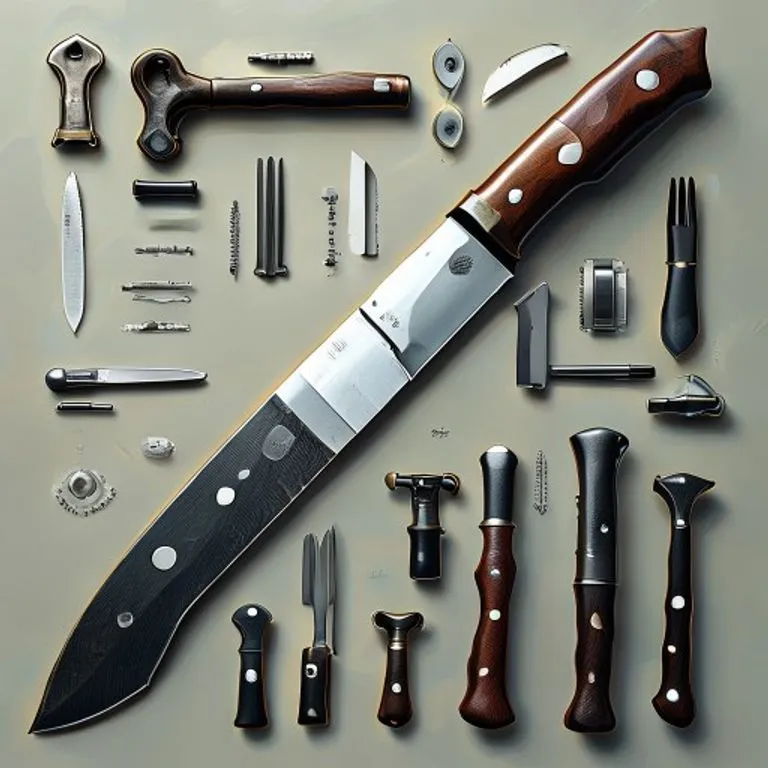
Made of
Brief description
A tool or weapon with a cutting edge or blade, usually attached to a handle or hilt. One of the earliest tools used by humanity, evolving from stone flakes to refined steel blades.
Use / Function
- Primary use: Cutting, slicing, and piercing materials.
- Secondary uses: Food preparation, self-defense, carving wood.
- Scale: Manual, individual use.
Operating principle
The knife operates on the principle of the wedge (an inclined plane).
- Concentrated Force: The force applied to the handle is concentrated on the extremely small surface area of the edge, creating immense pressure that separates material fibers.
How to create it
Minimum functional version
- Blade: Forge a piece of steel into a flat shape, then grind one edge to a bevel.
- Heat Treatment: Harden the blade (heat and quench) and temper it (reheat slightly) to balance hardness and toughness.
- Handle: Attach scales (wood/bone) to the tang using pins, Pine Resin Glue, or wrap with leather/cord.
- Sharpening: Hone the edge on a whetstone.
Technical level
- Basic to Advanced: Simple knives can be ground from scrap metal; high-quality knives require precise heat treatment and forging skills.
Materials needed
- Essential materials:
- Steel: High-carbon steel is preferred for edge retention (hardness) but stainless steel resists rust.
- Handle Material: Wood, bone, antler, or leather for grip.
- Tools:
- Forge/Torch: For heat treatment.
- Grinder/Files: For shaping the bevels.
- Whetstone: For sharpening.
Variants and improvements
- Fixed Blade: Stronger, no moving parts (e.g., survival knife, kitchen knife).
- Folding Knife: Safer for carry, blade folds into handle (e.g., pocket knife).
- Serrated Edge: Better for sawing through fibrous materials like rope or bread.
- Full Tang: The metal of the blade extends through the full length of the handle for maximum strength.
Limits and risks
- Brittleness: If too hard, the blade may chip or snap under impact or prying.
- Dullness: Requires regular maintenance (sharpening) to remain effective; a dull knife is more dangerous than a sharp one because it requires more force to cut, increasing slip risk.
- Corrosion: Carbon steel will rust if not kept dry and oiled.