Generated with AI2 min read
Chisel
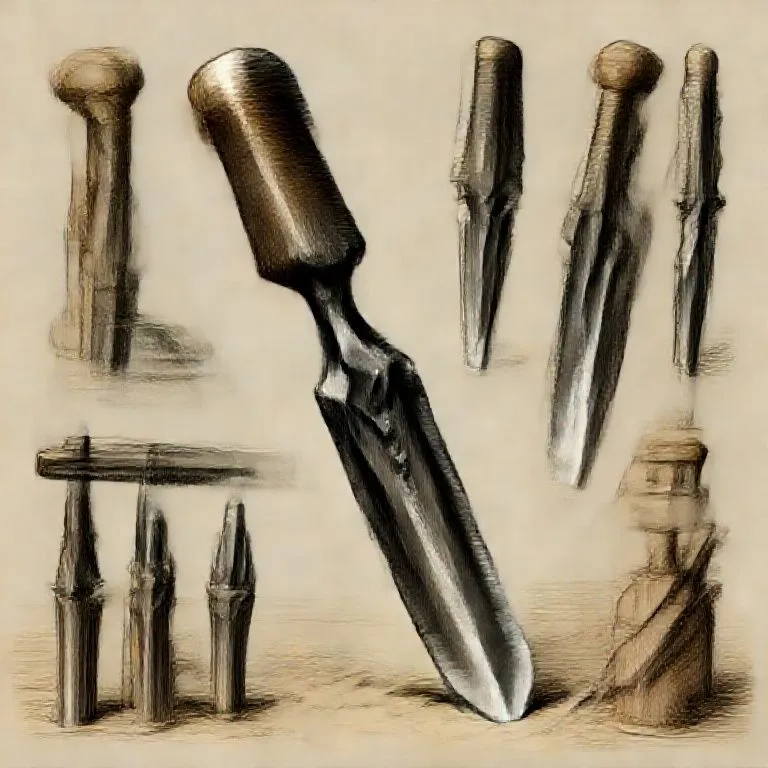
Brief description
A chisel is a tool with a characteristically shaped cutting edge of blade on its end, for carving or cutting a hard material such as wood, stone, or metal by hand, struck with a mallet, or applied with mechanical power.
Use / Function
- Woodworking: Carving joints (mortise and tenon), shaping wood, woodturning on a lathe. The Hand Plane uses a similar blade to achieve flat surfaces.
- Masonry: Cutting and shaping stone bricks or sculptures.
- Metalworking: Cutting cold metal (cold chisel) or removing waste material.
Operating principle
The wedge shape of the blade concentrates force onto a small area, splitting or shearing the material. When used with a lathe, it acts as a fixed cutting point against a moving surface.
How to create it
- Forging: Heat a metal rod (iron or steel) until malleable.
- Shaping: Hammer one end flat to create a blade.
- Hardening: Heat the blade to critical temperature and quench it (water or oil) to make it hard.
- Tempering: Reheat gently to reduce brittleness.
- Sharpening: Grind the edge to a precise angle (25-30 degrees for wood).
- Handle: Fit a wooden handle to the other end for grip and to absorb shock.
Materials needed
- Blade: High-carbon steel (best), iron (needs frequent sharpening), or flint/obsidian (primitive).
- Handle: Hardwood (ash, hickory) or bone.
Variants and improvements
- Gouge: Curved blade for carving hollows.
- Skew Chisel: Angled blade for smooth finishing on a lathe.
- Cold Chisel: Thick, tempered for cutting metal.
Limits and risks
- Dulling: Requires frequent sharpening to work effectively and safely.
- Chipping: If the steel is too brittle (bad temper), the edge will chip on hard knots.
- Safety: Always cut away from the body. A dull chisel is more dangerous than a sharp one because it requires excessive force.