Generated with AI2 min read
Axle
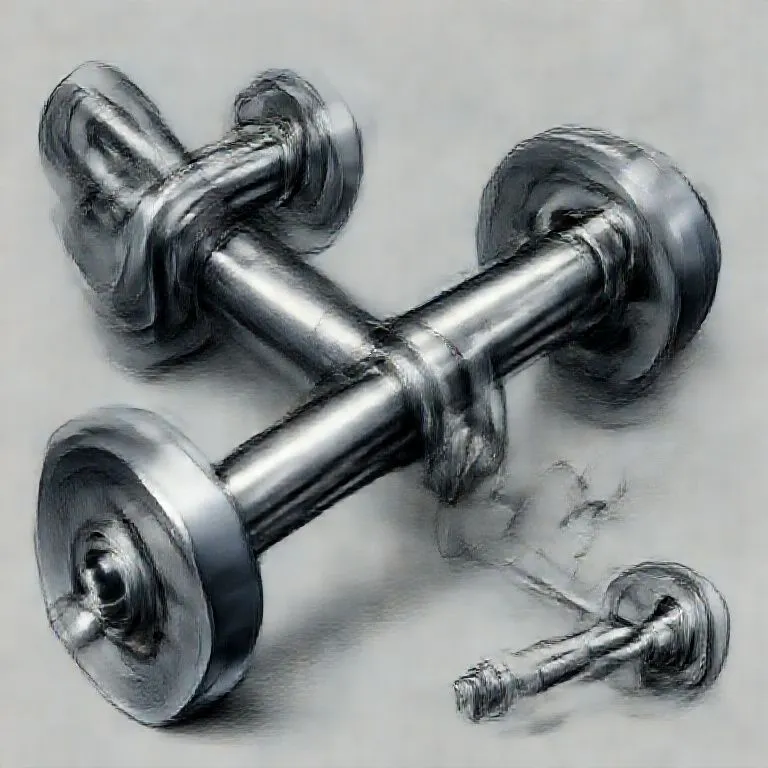
Brief description
An axle is a central shaft for a rotating wheel or gear. On wheeled vehicles, the axle may be fixed to the wheels, rotating with them, or fixed to the vehicle, with the wheels rotating around the axle.
Use / Function
- Support: It bears the weight of the vehicle and its load.
- Rotation: It allows the wheels to rotate, enabling movement.
- Torque Transmission: In driven systems, it transmits power from the engine/source to the wheels.
Operating principle
The axle acts as a fulcrum or a hinge point.
- Dead Axle: The axle is stationary (fixed to the frame), and the wheels rotate around it using bearings or grease to reduce friction.
- Live Axle: The axle rotates, and the wheels are fixed to it. The axle itself is supported by bearings on the vehicle frame.
How to create it
Basic Wooden Axle
- Selection: Choose a straight, strong branch or trunk of hardwood (e.g., oak, hickory).
- Shaping: Carve it into a perfect cylinder. The ends must be particularly smooth and uniform to fit the wheel hubs.
- Smoothing: Sand or polish the surface to minimize friction.
- Fitting: Ensure it fits tightly into the vehicle frame (for dead axles) or wheel hubs (for live axles).
Metal Axle
- Forging/Casting: Create a metal rod of uniform thickness.
- Machining: Use a lathe to ensure perfect cylindrical shape and smooth surface.
Materials needed
- Essential: Hardwood (Wood) or Metal (Iron/ Steel).
- Tools: Knife/Chisel (for wood), Hammer/Anvil (for metal), Measuring tools.
- Lubricant: Animal fat or oil is crucial for the bearing surfaces.
Variants and improvements
- Stub Axle: A short axle that supports only one wheel (used in modern car steering).
- Differential: A complex gear arrangement allowing wheels on the same axle to rotate at different speeds (for turning).
Limits and risks
- Breaking: If the axle is too thin or the wood has knots, it can snap under heavy load.
- Wear: Without lubrication, friction will quickly wear down the axle or the wheel hub, causing wobbling and eventual failure.
- Friction Heat: Excessive speed without lubrication can generate enough heat to char wood or damage metal.