Generated with AI3 min read
Anchor
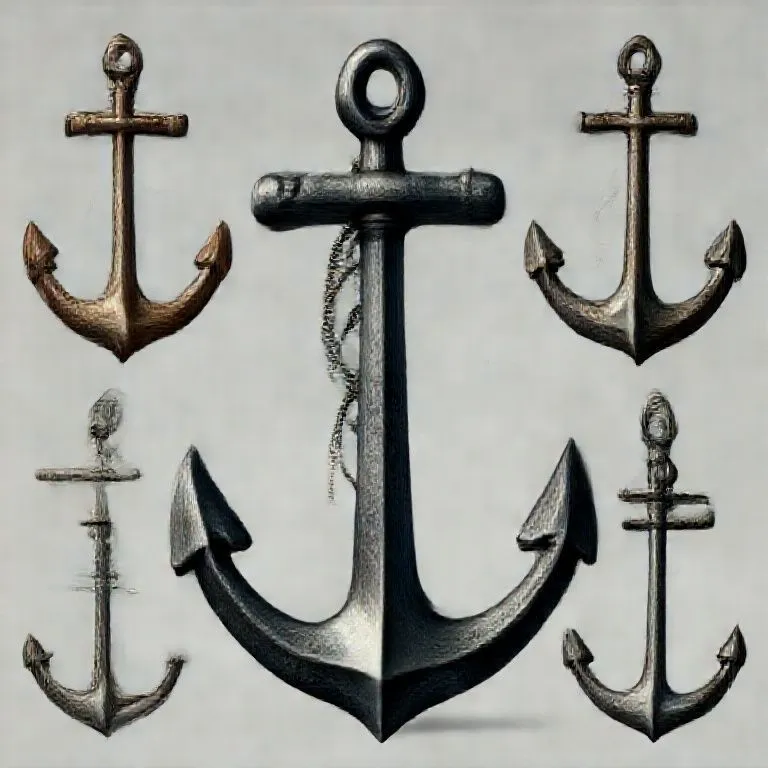
Brief description
An anchor is a device, normally made of metal, used to connect a vessel to the bed of a body of water to prevent the craft from drifting due to wind or current.
Use / Function
The primary purpose of an anchor is to keep a ship or boat in a specific location.
- Mooring: Keeping a vessel stationary while waiting for a berth, loading/unloading offshore, or resting.
- Safety: Preventing a ship from being dragged toward the shore or rocks during a storm.
- Navigation: In historical contexts, used to help turn a ship (warping maneuver).
Operating principle
Anchors work by resisting the movement of the vessel through two main mechanisms:
- Weight (Gravity): Simple heavy objects (Stone, concrete blocks) that rely on friction and mass to hold onto the bottom. Effective for small boats or on hard bottoms.
- Hooking (Shape): The anchor is designed to dig into the seabed. As the ship pulls, the flukes (points) bury themselves deeper. This is much more efficient than pure weight.
The Catenary Effect: Crucial for anchoring is the anchor line (rope or chain). A heavy chain forms a curve (catenary). The weight of the chain keeps the pull on the anchor horizontal, helping it stay dug in. If the pull is vertical, the anchor breaks free.
How to create it
1. Primitive Anchor (“Killick”)
- Concept: A stone trapped in a wooden cage or a bifurcated branch with a stone tied to it.
- Materials: A bifurcated tree branch, a heavy Stone, Rope or lashings.
- Method: Use the fork as a hook and tie the stone to provide weight.
2. Stock Anchor (Admiralty Style)
- Concept: A T-shaped iron device. The “stock” (crossbar) ensures the anchor falls flat so that one of the two flukes points down and digs in.
- Materials: Wrought Iron for the shank and arms, Wood or iron for the stock.
- Method: Forge-weld iron bars to form the cross. The stock is placed at 90 degrees to the arms.
Materials needed
- Stone: The simplest weight.
- Wood: For stocks or primitive hook structures.
- Iron: For strong, thin shanks and flukes that can penetrate sand/mud.
- Lead: Historically used for stocks to add weight in a compact form.
- Rope / Chain: Essential for connecting the anchor to the boat.
Variants and improvements
- Stockless Anchor: Modern anchors (like the Hall anchor) where the flukes pivot. The stock is eliminated so the anchor can be drawn into the ship’s hawsepipe.
- Mushroom Anchor: Shaped like a mushroom, used for permanent moorings in soft silt.
- Danforth Anchor: Lightweight with large flat plates, excellent holding power in sand/mud relative to its weight.
Limits and risks
- Dragging: If the wind/current is too strong, or the bottom is too hard/soft, the anchor may not hold and the ship will drag it.
- Fouling: The rope can wrap around the anchor protruding from the bottom, pulling it out.
- Loss: If the anchor gets stuck under a rock, the line may have to be cut, losing the anchor.
- Scope: A length of line 3 to 7 times the water depth is needed for the anchor to work effectively.