Generated with AI3 min read
Wheel
Made of
Brief description
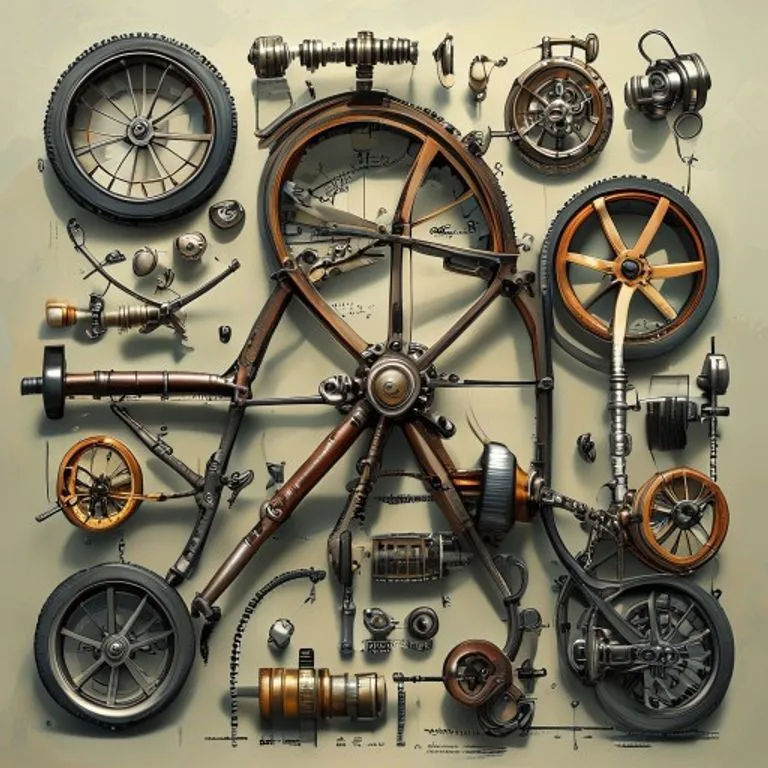
A circular component that is intended to rotate on an axle bearing. The wheel is one of the key components of the wheel and axle which is one of the six simple machines. It allows heavy objects to be moved easily facilitating movement or transportation while supporting a load, or performing labor in machines.
Use / Function
- Transportation: Fundamental for carts, wagons, chariots, and Bicycles.
- Machinery: Essential for gears, flywheels, water wheels, and potter’s wheels.
- Energy Conversion: Transforms linear motion into rotary motion and vice versa.
Operating principle
The wheel reduces friction by facilitating motion by rolling together with the use of an axle.
- Rolling Friction: Rolling friction is significantly lower than sliding friction.
- Leverage: A wheel is a continuous lever, with the fulcrum at the contact point with the ground.
Structure
The effectiveness of the wheel depends on its structural integrity and the proper assembly of its components.
- Hub: The central part of the wheel through which the axle passes. In spoked wheels, it anchors the spokes.
- Spokes: Rods radiating from the hub to the rim. They support the rim and transfer the load from the hub. The arrangement of these is known as Spoke Lacing.
- Rim: The outer circular part of the wheel. It holds the tire and connects to the spokes.
- Tire: A band (metal or leather) placed around the rim to protect it from wear and hold the wheel together.
How to create it
For a detailed guide on the craft of wheelwrighting, see Wheel Construction.
Solid Wood Wheel (Basic)
- Selection: Find a large log of hardwood (oak, elm).
- Cutting: Saw a slice (disk) from the log.
- Shaping: Ensure it is circular.
- Boring: Drill a hole in the exact center for the axle.
- Reinforcing: Use cross-planks or metal bands to prevent splitting.
Spoked Wheel (Advanced)
- Hub: Create a central hub with mortises for spokes.
- Rim: Bend wood (using steam) or assemble curved segments (felloes) to form a circle.
- Spokes: Insert spokes connecting the hub to the rim.
- Tire: Shrink-fit a metal tire (iron or bronze) around the rim to hold it all together and provide durability.
Materials needed
- Wood: Seasoned hardwood for durability.
- Metal: Iron or bronze for the tire and hub reinforcement.
- Tools: Saw, chisel, drill, hammer.
Variants and improvements
- Potter’s Wheel: A horizontal wheel used for shaping clay.
- Water Wheel: A wheel with blades or buckets to harness water energy.
- Gear: A toothed wheel for transmitting torque.
- Pulley: A wheel with a grooved rim for a rope or chain.
Limits and risks
- Terrain: Wheels require relatively smooth surfaces to be effective.
- Friction: The axle bearing generates friction and heat; lubrication is essential.
- Maintenance: Spoked wheels are complex and can break under stress; solid wheels are heavy and can split.