Generated with AI3 min read
Wagon
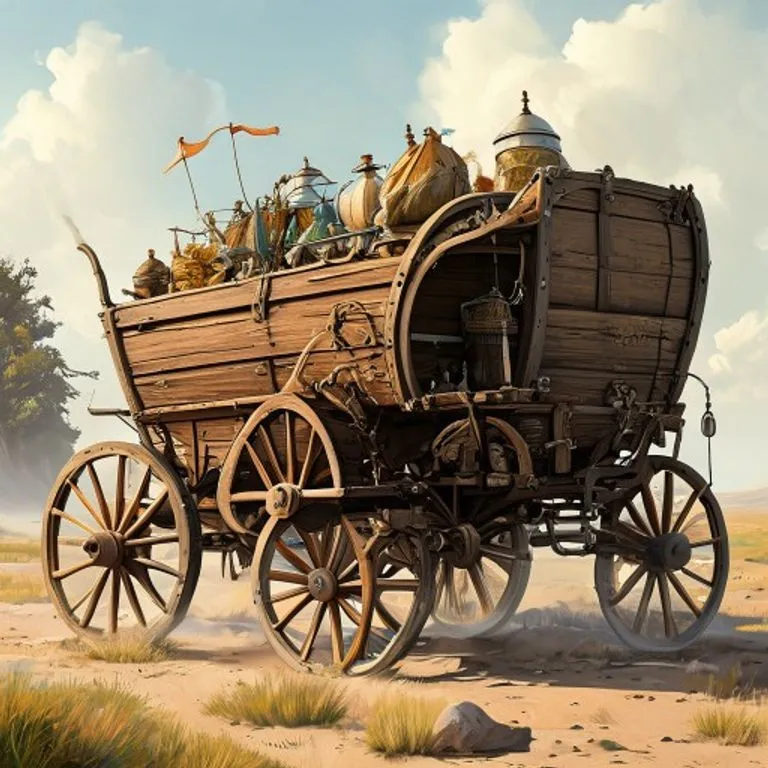
Brief description
A wagon is a four-wheeled vehicle designed for transporting heavy loads, typically pulled by draft animals (horses, oxen, mules). Unlike a cart, which has two wheels, a wagon is self-supporting and stable when stationary, allowing for much larger capacities.
Use / Function
- Heavy Transport: Moving large quantities of goods, crops, or raw materials.
- Migration: Used historically for long-distance travel and carrying household goods (e.g., covered wagons).
- Military Logistics: Transporting supplies and ammunition.
Operating principle
The wagon relies on four wheels to distribute weight more evenly than a cart.
- Stability: With four points of contact, the wagon does not tip forward or backward like a cart might.
- Steering: To turn, the front axle must be able to pivot relative to the frame. This requires a “fifth wheel” or a pivot pin mechanism.
- Rolling Resistance: Like the cart, wheels reduce friction compared to dragging.
How to create it
- Frame: Construct a large, sturdy rectangular frame from hardwood beams.
- Rear Axle: Fix the rear axle rigidly to the frame.
- Front Axle & Steering: Create a pivoting mechanism for the front axle. A simple version uses a central pin (kingpin) connecting the front axle assembly to the frame, allowing it to swivel.
- Wheels: Mount four sturdy wheels. Often, rear wheels are larger to carry more weight and roll easier, while front wheels are smaller to allow for tighter turns (so they don’t hit the frame).
- Draft Gear: Attach a tongue or pole to the front axle assembly to connect to the animals via a yoke or a Horse Collar harness.
Materials needed
- Wood: Hardwood (oak, ash) for the frame, axles, and wheels.
- Iron: For the kingpin, tires, axle bearings, and structural reinforcement.
- Leather/Rope: For harnessing the animals.
- Grease: Essential for lubricating the axles and the steering pivot.
Variants and improvements
- Covered Wagon: Features a canvas roof stretched over wooden hoops to protect contents from weather.
- Carriage: A refined wagon with suspension (springs) for transporting people comfortably.
- Coach: An enclosed carriage.
Limits and risks
- Turning Radius: Wagons have a wider turning radius than carts. If the front wheels hit the frame (lock), the wagon cannot turn further.
- Terrain: Requires relatively flat and wide paths. Difficult to maneuver in dense forests or steep mountains.
- Complexity: The steering mechanism adds mechanical complexity and a potential failure point compared to a simple cart.