Generated with AI3 min read
Sawmill
Brief description
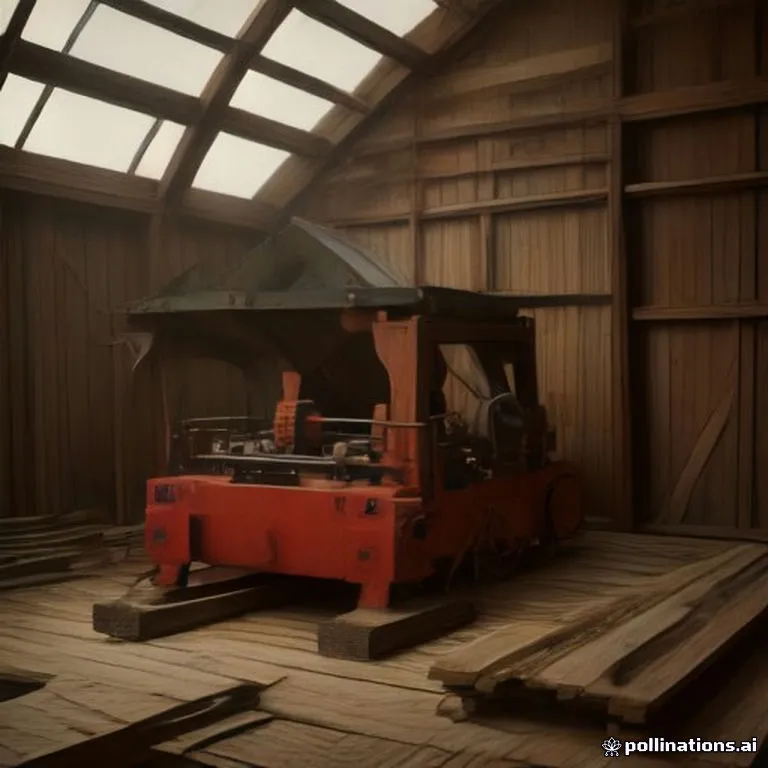
A facility or mechanical device designed to process harvested tree trunks into dimensional timber, boards, and beams using power-driven saw blades. Driven by water wheels, wind turbines, or steam engines, the sawmill transformed timber processing from laborious manual pit sawing into a high-throughput industrial cornerstone.
Use / Function
- Primary Use: Rapid conversion of raw timber logs into standardized construction lumber, planks, and beams.
- Secondary Uses: Processing wood waste (sawdust and offcuts) for charcoal production, paper pulp, or boiler fuel.
- Scale: Community watermills to industrial steam-powered lumber complexes.
Operating principle
- Motive Power: Mechanical energy from a Water Wheel, Windmill, or Steam Engine drives a central drive shaft.
- Motion Conversion: A crank or eccentric mechanism transforms rotary shaft motion into reciprocating up-and-down sawing action, or directly spins a circular blade.
- Log Feeding: A ratcheted carriage mechanism advances the heavy timber log into the moving blade step-by-step with each stroke.
- Cutting: High-speed steel or iron saw teeth slice through wood fibers along the grain, producing uniform boards.
How to create it
- Frame & Carriage: Construct a sturdy heavy timber bed and carriage with iron rails to hold and advance logs straight into the saw blade.
- Saw Mechanism: Mount a long, thick pit-saw blade vertically inside a rigid wooden frame (sash saw) connected to a pitman arm, or mount a circular blade on an arbor.
- Drive Linkage: Connect a crankshaft to the motive source (such as a waterwheel axle) using leather belts or iron gears.
- Feed Mechanism: Install a pawl-and-ratchet gear driven by the saw frame’s movement to automatically advance the carriage forward on each upstroke.
Materials needed
- Frame & Carriage: Heavy Wood timber and Iron rails/hardware.
- Blades: Hardened Steel or wrought iron with tempered steel teeth.
- Linkage & Bearings: Cast Iron crankshafts and bronze or wooden bearings.
- Power Coupling: Leather drive belts or iron gearing.
Variants and improvements
- Pit Sawing: Hand-operated two-person saw pit (pre-industrial predecessor).
- Sash Sawmill: Single vertical blade held in a frame, driven by a simple waterwheel crank.
- Gang Sawmill: Multiple parallel blades fixed in one frame to cut an entire log into multiple planks in a single pass.
- Circular Sawmill: Spinning circular blade allowing continuous, high-speed cutting without reciprocating dead stops.
- Band Sawmill: Continuous flexible steel band running over two wheels for thin kerf cuts and minimal wood waste.
Limits and risks
- Kickback and Blade Shatter: Fast-moving blades can shatter or throw wood under stress; protective shielding is essential.
- Mechanical Wear: High friction generates heat, dulling teeth quickly and requiring frequent filing and tension adjustment.
- Fire Hazard: Accumulation of dry sawdust near high-friction bearings poses a severe fire risk.