Generated with AI3 min read
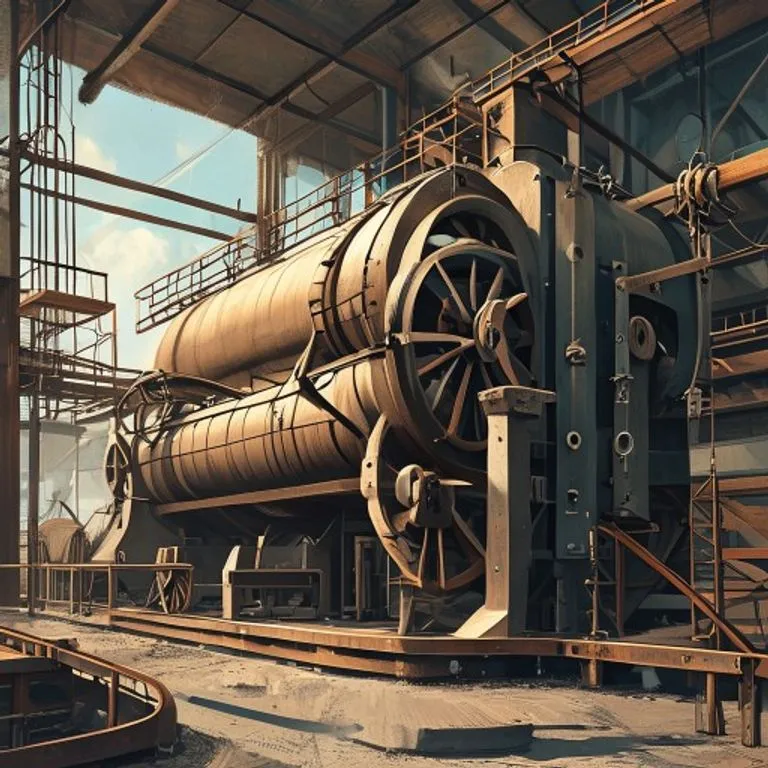
Rolling Mill
Brief description
A machine used to reduce the thickness of metal sheets or bars and to make them uniform. The metal stock is passed through one or more pairs of rolls to reduce the thickness and to make the thickness uniform. The concept is similar to the rolling of dough.
Use / Function
- Primary Use: To flatten metal ingots into sheets, plates, or foil.
- Secondary Uses: To shape metal into bars, rods, rails (I-beams), or wire.
- Scale: Industrial (large mills driven by water wheels or steam engines) to small jeweler’s mills.
Operating principle
The metal is passed between two rotating rolls. The gap between the rolls is slightly smaller than the thickness of the incoming metal. As the metal is pulled through by friction, it is compressed and elongated.
- Hot Rolling: Metal is heated above its recrystallization temperature. Easier to shape, but surface finish is rougher.
- Cold Rolling: Metal is rolled at room temperature. Harder to shape (requires more force), but produces better surface finish and strength (work hardening).
How to create it
Basic Two-High Mill
- Rolls: Two heavy, smooth cylinders of Cast Iron or hardened Steel.
- Housing (Frame): A massive, rigid frame to hold the rolls in place against the enormous separating forces.
- Bearings: Heavy-duty Slide Bearings (often bronze or brass) or Ball and Roller Bearings to support the roll necks.
- Screw-down Mechanism: Large screws on top of the housing to adjust the gap between the rolls (the “nip”).
- Drive: A powerful source of torque (Water Wheel, Steam Engine, or Electric Motor) connected to the rolls via Gears.
- Flywheel: A massive Flywheel is often used to store energy and smooth out the power delivery, especially for “bite” when the metal first enters the rolls.
Materials needed
- Rolls: Hardened Steel or chilled Cast Iron.
- Frame: Cast Iron or thick Steel plate.
- Bearings: Bronze, Brass, or Babbitt metal.
- Lubricant: Heavy grease or tallow.
Variants and improvements
- Two-High: Two rolls, rotates one way (reversing mills can go back and forth).
- Three-High: Three rolls stacked vertically. Metal goes one way through bottom gap, returns through top gap.
- Four-High: Two small work rolls (contact the metal) backed up by two large backup rolls (prevent bending).
- Cluster Mill: Many backup rolls for very hard materials/thin foils.
Limits and risks
- Force: Requires immense force; frames can crack if not strong enough.
- Pinching: Extremely dangerous for operators; fingers/limbs can be pulled in.
- Chatter: Vibration can mark the metal surface.
- Camber: Rolls can bend in the middle under load, producing sheet that is thicker in the center (crowned).