Generated with AI2 min read
Hand Axe
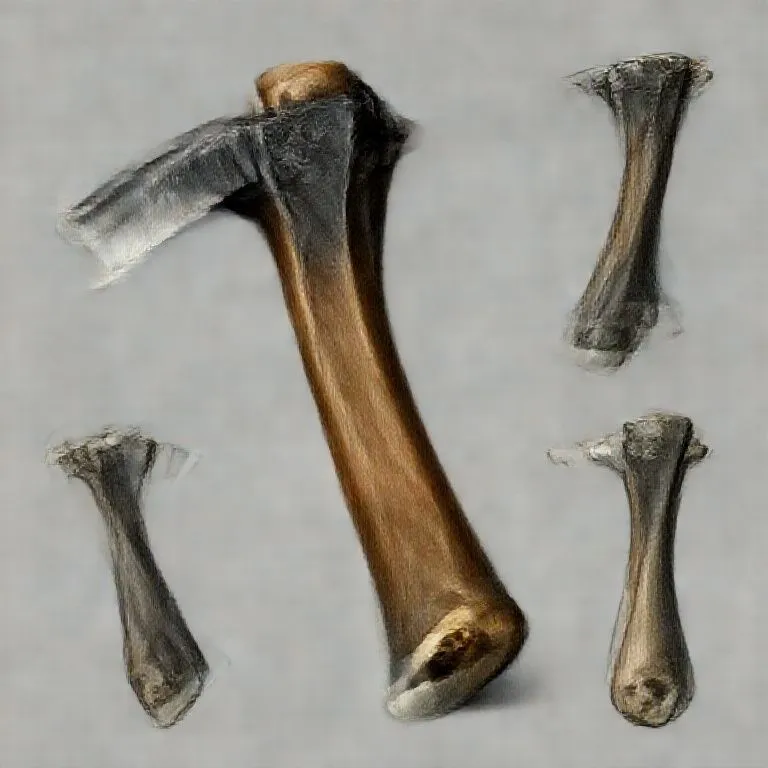
Brief description
A hand axe is a prehistoric stone tool, characteristically bifacial (worked on both sides) and almond or teardrop-shaped. It is considered the “Swiss Army knife” of the Stone Age due to its versatility. It is held directly in the hand, without a handle.
Use / Function
- Cutting: Butchering animals and cutting meat.
- Chopping: Cutting wood or hacking through vegetation.
- Digging: Loosening soil to find roots or tubers.
- Scraping: Preparing hides (though less specialized than a scraper).
Operating principle
Wedge: The hand axe functions as a wedge. The sharp edges concentrate force to separate material, while the weight of the stone provides momentum for chopping.
How to create it
- Selection: Find a suitable nodule of flint, chert, obsidian, or other hard, fracture-prone stone.
- Roughing out: Use a hard hammerstone (a rounded river stone) to strike off large flakes from the nodule, creating a rough shape.
- Shaping: Use a softer hammer (antler, bone, or softer stone) to thin the tool and refine the shape, working on both faces (bifacial knapping) to create a sharp edge all around.
- Finishing: Use pressure flaking (pressing with an antler tip) to sharpen and straighten the edge.
Materials needed
- Core Stone: Flint, chert, obsidian, quartzite, or basalt.
- Hammerstone: A hard, rounded stone for initial percussion.
- Soft Hammer: Antler billet, bone, or hard wood for thinning.
- Pressure Flaker: Antler tine or copper tip for fine detailing.
Variants and improvements
- Oldowan Chopper: Earlier, simpler tool with only one worked edge.
- Acheulean Hand Axe: The classic teardrop shape, symmetrical and carefully worked.
- Mousterian: Smaller, more refined tools made from prepared cores (Levallois technique).
- Hafted Axe: Later versions attached to a wooden handle for greater leverage (evolves into the modern axe).
Limits and risks
- Range: Requires close contact with the target (no handle).
- Safety: Can cut the user’s hand if not held correctly or if the edge is not dulled near the grip.
- Durability: Stone is brittle and can shatter if struck against a hard surface incorrectly.