Generated with AI3 min read
Heat Exchanger
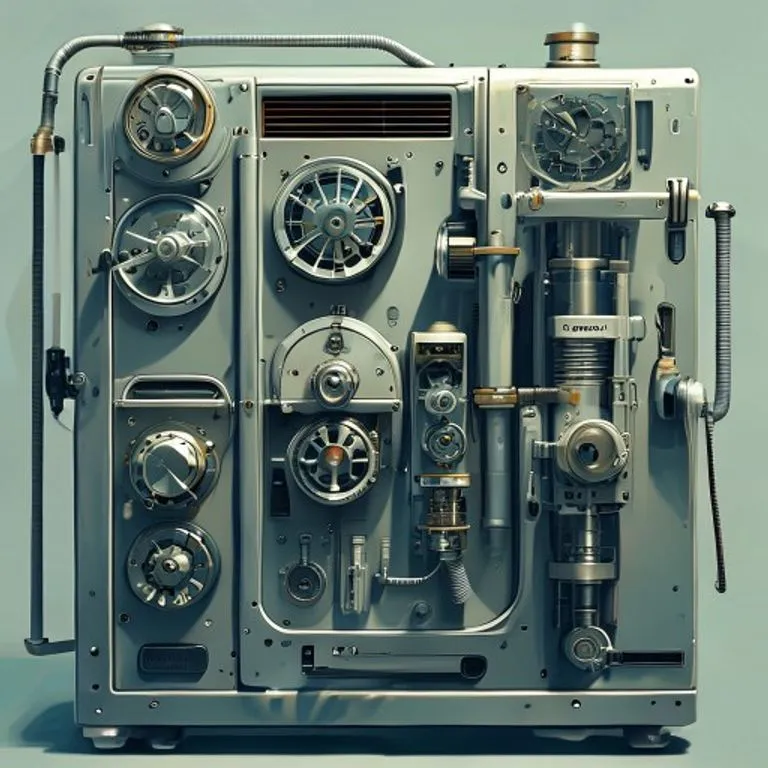
Brief description
A heat exchanger is a system used to transfer heat between a source and a working fluid. Heat exchangers are used in both cooling and heating processes. The fluids may be separated by a solid wall to prevent mixing or they may be in direct contact.
Use / Function
- Refrigeration and Air Conditioning: Transferring heat from a cooled space to the outside environment. See Mechanical Refrigeration.
- Power Plants: Condensing steam back into water or preheating water for a Boiler.
- Internal Combustion Engines: Removing excess heat from the engine block via a radiator. See Internal Combustion Engine.
- Chemical Processing: Controlling the temperature of chemical reactions.
- Distillation: Cooling vapors to condense them back into liquid. See Distillation.
Operating principle
Heat exchangers work by providing a large surface area for heat to move from a hotter fluid to a cooler one, typically through a conductive material like metal.
- Conduction: Heat moves through the walls of the tubes or plates separating the fluids.
- Convection: Heat is carried away from the surface by the flow of the fluids.
- Flow Patterns:
- Parallel Flow: Both fluids move in the same direction.
- Counter-Flow: Fluids move in opposite directions (most efficient for heat transfer).
- Cross-Flow: Fluids move perpendicular to each other (common in radiators).
How to create it
1. Shell and Tube (Most common industrial type)
- Construct a large outer cylinder (the shell).
- Place a bundle of smaller tubes inside the shell.
- One fluid flows through the tubes, while the other flows around them inside the shell.
2. Plate Heat Exchanger
- Stack several thin metal plates with spaces between them.
- Fluids flow through alternating spaces, allowing for a massive surface area in a compact volume.
3. Finned Tube (Radiator style)
- Attach thin metal fins to the outside of a pipe.
- As fluid flows through the pipe, a fan or natural air current blows across the fins, rapidly removing heat.
Materials needed
- Highly Conductive Metals: Copper and Aluminum are best for heat transfer.
- Corrosion-Resistant Metals: Steel or Stainless Steel for high pressure or corrosive fluids.
- Seals and Gaskets: To prevent leaks between the two fluid paths.
Variants and improvements
- Radiator: A specific type of heat exchanger designed to cool a liquid using air.
- Condenser: Designed to change a gas into a liquid by removing heat.
- Evaporator: Designed to change a liquid into a gas by adding heat.
Limits and risks
- Fouling: Accumulation of scale, rust, or biological matter on the surfaces, which reduces efficiency.
- Corrosion: Fluids can eat away at the metal walls, leading to leaks and mixing.
- Thermal Stress: Rapid temperature changes can cause the metal to expand or contract, potentially cracking the structure.
- Pressure Drop: Pushing fluid through narrow tubes or spaces requires significant pumping power.