Generated with AI2 min read
Mechanical Refrigeration
Brief description
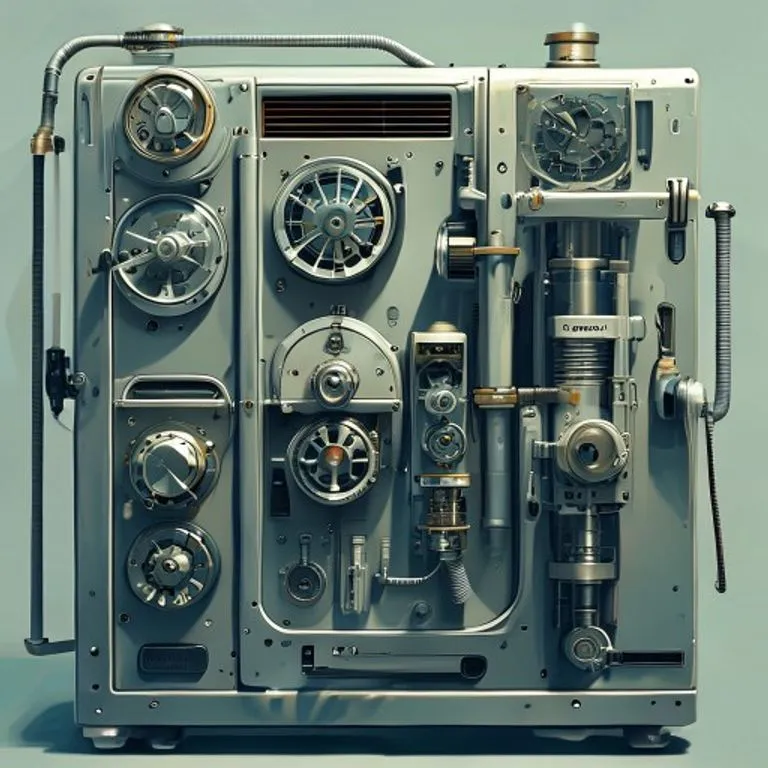
Mechanical refrigeration is the process of removing heat from a space or substance using a mechanical system. Unlike natural refrigeration, it can achieve temperatures much lower than the surroundings and maintain them indefinitely by using external energy to drive a refrigeration cycle.
Use / Function
- Food Preservation: Extending the shelf life of perishables significantly.
- Medicine: Storing vaccines, blood, and medications.
- Industrial Processes: Cooling chemical reactions and manufacturing processes.
- Air Conditioning: Regulating the temperature of living and working spaces.
Operating principle
Most mechanical refrigeration uses the Vapor-Compression Cycle:
- Compression: A compressor increases the pressure and temperature of a gaseous refrigerant (like Ammonia).
- Condensation: The hot gas flows through a condenser (coils), where it releases heat to the surroundings and condenses into a high-pressure liquid.
- Expansion: The liquid passes through an expansion valve, where its pressure drops rapidly, causing it to cool down significantly.
- Evaporation: The cold liquid flows through evaporator coils in the space to be cooled. It absorbs heat from the space and evaporates back into a gas.
- Return: The gas returns to the compressor to start the cycle again.
How to create it
Basic Compression System
- Level: Advanced.
- Compressor: A mechanical pump (reciprocating or rotary) to compress the refrigerant.
- Coils: Copper or steel tubing for the condenser and evaporator.
- Expansion Valve: A precise orifice or valve to control the flow and pressure drop.
- Refrigerant: A substance with a low boiling point, like Ammonia.
Materials needed
- Refrigerant: Ammonia (efficient but toxic) or hydrocarbons.
- Tubing: Copper (excellent heat transfer) or Steel.
- Compressor: Iron and Steel.
- Insulation: Cork, Mineral Wool, or fiberglass.
Variants and improvements
- Absorption Refrigeration: Uses a heat source (like a flame) instead of a mechanical compressor.
- Thermoelectric Cooling: Uses the Peltier effect (no moving parts, but less efficient).
- Modern Refrigerants: Use of CFCs (now banned) and HFCs/HFOs to avoid toxicity and ozone depletion.
Limits and risks
- Energy Consumption: Requires continuous external power.
- Toxic Leaks: Ammonia is highly toxic and corrosive.
- Mechanical Failure: Compressors have moving parts that eventually wear out.
- Global Warming: Many synthetic refrigerants are potent greenhouse gases.