Generated with AI3 min read
Steam Turbine
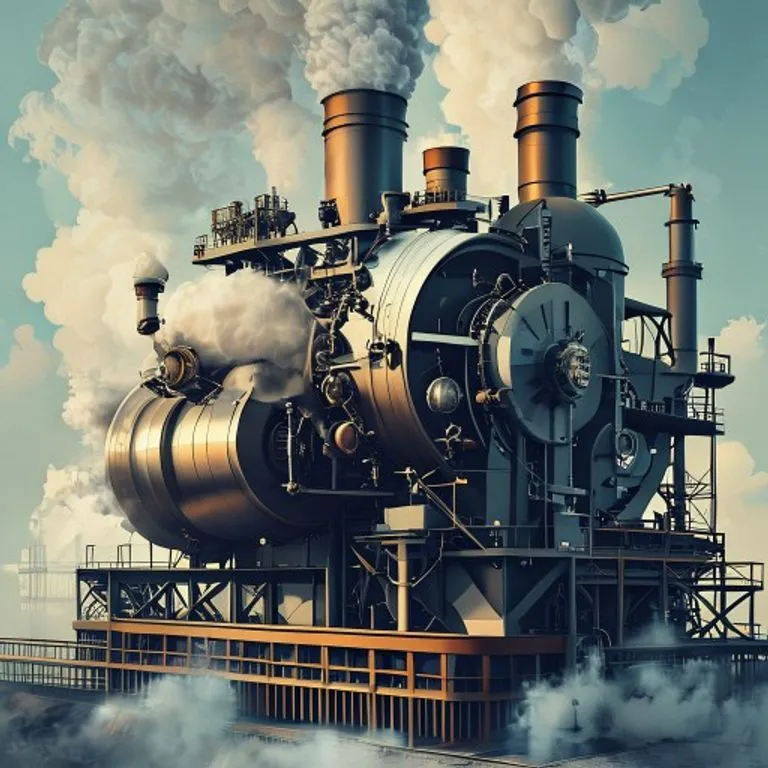
Brief description
A steam turbine is a device that extracts thermal energy from pressurized steam and uses it to do mechanical work on a rotating output shaft. Unlike the reciprocating Steam Engine, which uses pistons, the turbine produces direct rotary motion, making it exceptionally efficient and capable of high speeds.
Use / Function
- Electricity Generation: The primary use today; steam turbines drive the generators in most thermal and nuclear power plants.
- Marine Propulsion: Powering large ships and submarines.
- Industrial Drives: Powering large pumps, compressors, and fans.
- Scale: Industrial and mass utility.
Operating principle
The steam turbine operates by converting the potential energy of pressurized steam into kinetic energy, and then into rotational mechanical energy.
- Expansion: High-pressure steam is directed through nozzles. As it expands, it accelerates to high velocities.
- Impulse/Reaction: The high-speed steam hits blades mounted on a rotor.
- Impulse turbines: The steam hits the blades like a jet, pushing them forward.
- Reaction turbines: The steam expands further as it passes through the blades, pushing them back (like a rocket).
- Rotation: The force on the blades turns the shaft, providing mechanical power.
- Staging: Most turbines use multiple rows of blades (stages) to extract as much energy as possible from the steam as its pressure drops.
How to create it
Creating a functional steam turbine requires a much higher level of precision than a reciprocating engine.
- Level: Advanced.
- Rotor: A central shaft with precisely shaped blades (airfoils). The blades must be perfectly balanced to prevent catastrophic vibration at high speeds.
- Casing: A pressure-tight shell that directs the steam through the blades and prevents leakage.
- Bearings: High-quality Bearings capable of handling extremely high rotational speeds (thousands of RPM).
- Seals: To prevent steam from escaping along the shaft.
Materials needed
- Steel: High-strength steel for the shaft and casing. Special heat-resistant alloys are needed for high-efficiency turbines.
- Iron: For the outer casing or base structures.
- Water: The working fluid (boiled into steam).
- Coal: Or another fuel source to provide the heat.
- Lubricants: High-grade oil or Animal Fat for the bearings.
Variants and improvements
- De Laval Turbine: A simple single-stage impulse turbine (very high speed, low efficiency).
- Parsons Turbine: The first successful multi-stage reaction turbine, much more efficient for large-scale power.
- Condensing Turbine: Uses a condenser to create a vacuum at the exhaust, greatly increasing efficiency.
Limits and risks
- Precision Requirement: Any imbalance in the rotor can cause the turbine to explode at high speeds.
- Thermal Stress: Rapid changes in temperature can warp the blades or casing.
- Complexity: Requires advanced metallurgy and machining capabilities.
- Cavitation/Erosion: High-speed steam or water droplets can erode the blades over time.
Related Inventions
- Steam Engine: The predecessor technology.
- Electric Generator: The primary application.
- Boiler: Required to produce the steam.
- Bearings: Critical for high-speed rotation.