Generated with AI3 min read
Electroscope
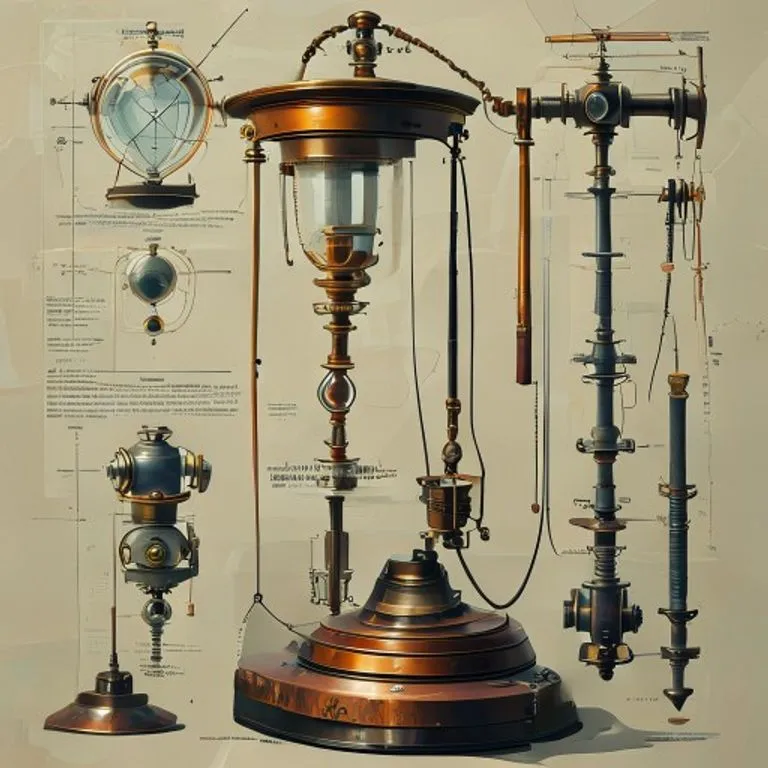
Brief description
An electroscope is a scientific instrument used to detect the presence and magnitude of electric charge on a body. It was one of the first electrical measuring instruments and played a crucial role in the early study of electricity.
Use / Function
- Detecting Charge: Determining if an object is electrically charged.
- Measuring Intensity: Estimating the amount of charge (more separation of the leaves means more charge).
- Identifying Polarity: Determining if a charge is positive or negative (when compared with a known charge).
- Radiation Detection: Measuring ionizing radiation, which causes the electroscope to discharge (like in the gold-leaf electroscope used by Victor Hess).
Operating principle
The electroscope works on the principle of electrostatic repulsion:
- Induction or Contact: When a charged object is brought near or touches the metal terminal at the top, the charge spreads down through the conductive rod to the metal leaves.
- Repulsion: Both leaves receive the same type of charge (positive or negative). Since like charges repel each other, the leaves push away from each other.
- Equilibrium: The leaves reach a point of balance between the electrical repulsion pushing them apart and the force of gravity pulling them down.
How to create it
- The Container: Take a clear Glass jar with a non-conductive lid (cork, rubber, or dry wood).
- The Conductor: Run a thick Metal wire or rod through the center of the lid. Ensure it is held firmly but insulated from the jar itself.
- The Terminal: Attach a metal ball or disk to the top of the wire (outside the jar) to act as a collector.
- The Leaves: At the bottom of the wire (inside the jar), hang two very thin, lightweight strips of Gold, Silver, or aluminum foil. They should be close together but free to move.
- Sealing: Seal the jar to prevent air currents from moving the leaves and to keep the interior dry, as humidity can leak the charge away.
Technical Level: Intermediate. Requires delicate handling of very thin metal foils.
Materials needed
- Conductor: Copper or Brass wire.
- Sensitive Leaves: Gold leaf is best, but thin aluminum foil works.
- Insulation: Clear Glass jar and an insulating stopper.
- Terminal: A metal sphere or plate.
Variants and improvements
- Pith-Ball Electroscope: Uses a lightweight ball (pith) hanging from a silk thread. Simpler but less sensitive.
- Gold-Leaf Electroscope: The classic, highly sensitive version described above.
- Quadrant Electrometer: A more complex version that can provide precise voltage measurements.
Limits and risks
- Humidity: Water vapor in the air can make the air conductive, causing the electroscope to lose its charge quickly.
- Fragility: The metal leaves are extremely thin and can be easily torn or stuck together.
- Limited Precision: It is more of an indicator than a precision measuring tool.