Generated with AI2 min read
Cistern
Brief description
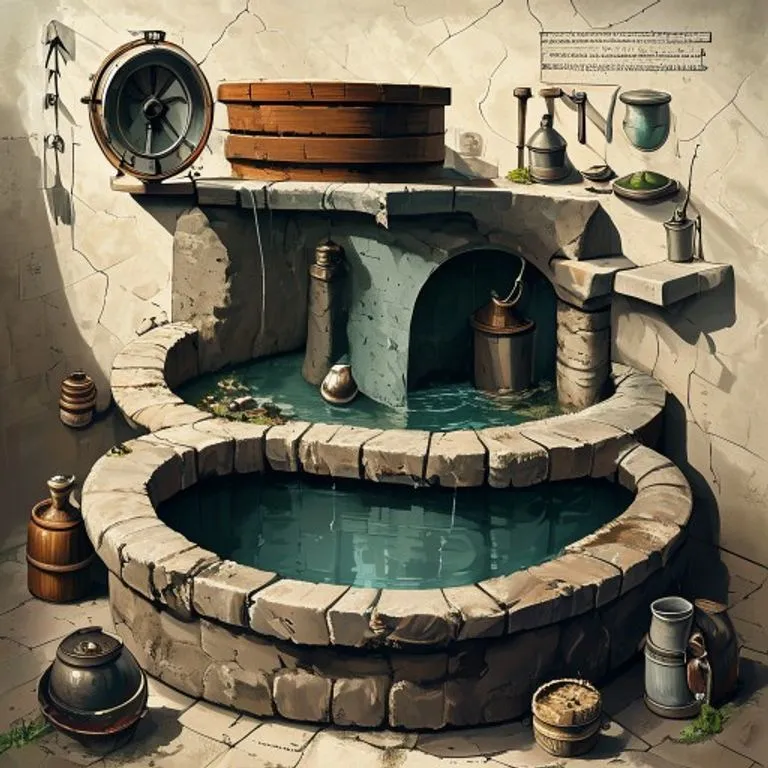
A waterproof receptacle for holding liquids, usually water. Cisterns are often built to catch and store rainwater.
Use / Function
- Primary use: Storing rainwater for household use (drinking, washing).
- Secondary uses: Emergency water storage, fire fighting reserve.
- Scale: Household (tank) to castle/fortress (underground vault).
Operating principle
- Catchment: Rain falls on a roof or catchment area.
- Conveyance: Gutters and downspouts direct water to the cistern.
- Filtration: A “first flush” diverter or filter removes debris before entering the tank.
- Storage: The tank holds water in a dark, cool environment to prevent algae growth.
How to create it
- Excavation: Dig a hole for underground cisterns (keeps water cool).
- Lining: Build walls with brick, stone, or concrete.
- Waterproofing: Apply a layer of waterproof mortar (cement + sand + waterproofing agent) or a plastic liner.
- Covering: Seal the top to prevent evaporation, mosquito breeding, and contamination.
- Access: Install a hatch for cleaning and a pump/bucket system for extraction.
Materials needed
- Structure: Concrete (ferrocement is excellent), Brick, Plastic (modern tanks).
- Waterproofing: Hydraulic mortar, bitumen (outside only), or liners.
- Plumbing: Gutters and pipes.
Variants and improvements
- Ferrocement Tank: Thin shell of mortar reinforced with chicken wire. Very strong and cheap.
- Rain Barrel: Simple collection from a downspout into a Barrel.
- Impluvium: Roman style pool in a courtyard to catch rain.
Limits and risks
- Contamination: Bird droppings on the roof can pollute water. First-flush diverters are essential.
- Mosquitoes: Standing water breeds disease vectors if not sealed.
- Algae: Sunlight promotes algae; cisterns must be opaque/covered.
- Cracking: Leaks can drain the entire supply and undermine foundations.
Related inventions
- Gutter: Collection mechanism.
- Water Filter: Essential post-treatment.
- Water Supply: Alternative to centralized supply.
- Concrete: Common material.