Generated with AI3 min read
Typewriter
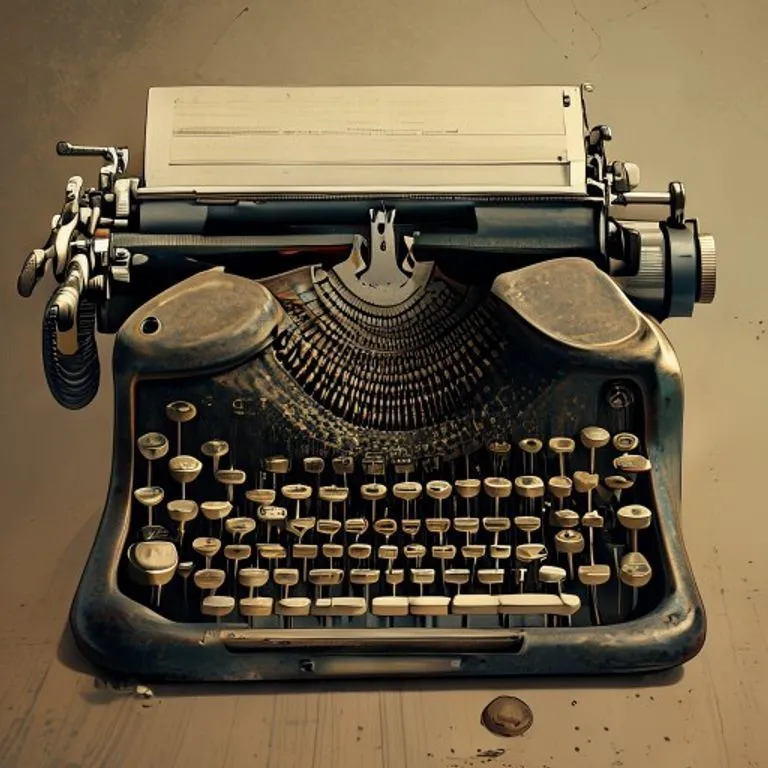
Brief description
A mechanical machine for writing characters similar to those produced by a printer’s movable type. It allows for the rapid production of legible, standardized documents by pressing keys that strike an inked ribbon against paper.
Use / Function
- Primary use: Rapid production of legible text and documents.
- Secondary uses: Creating multiple copies using carbon paper, standardized record-keeping, and professional correspondence.
- Scale: Personal, office, and administrative use.
Operating principle
The typewriter converts the kinetic energy of a finger strike into a mechanical movement that imprints a character:
- Key Strike: Pressing a key acts as a lever.
- Typebar Movement: The lever pivots a typebar (a metal arm with a raised character at the end).
- Inking: The character strikes an Ink-saturated ribbon.
- Imprint: The ribbon is pressed against the Paper, leaving an image of the character.
- Escapement: A mechanism advances the carriage (holding the paper) by one character space after each strike.
- Carriage Return: At the end of a line, a lever returns the carriage and advances the paper to the next line.
How to create it
Creating a typewriter requires high-precision machining and complex mechanical synchronization.
- Frame: A rigid Cast Iron or Steel frame to maintain alignment.
- Keyboard: A series of levers connected to typebars.
- Type Basket: An arrangement of typebars in a circular or semi-circular “basket” so they all strike the same central point.
- Escapement Mechanism: A critical component consisting of a notched rack and a pawl that allows the carriage to move exactly one space at a time under spring tension.
- Platen: A cylindrical roller (often covered in Natural Rubber) that holds and advances the paper.
- Ribbon Advance: A mechanism to move the ink ribbon slightly after each strike to ensure fresh ink is always available.
Materials needed
- Frame and Levers: Steel and Iron for durability and precision.
- Platen: Wood or metal core covered with Natural Rubber to provide a firm but slightly resilient surface.
- Typebars: Hardened Steel to prevent the characters from deforming over time.
- Consumables: Paper and Ink-soaked fabric (silk or cotton) ribbons.
Variants and improvements
- Index Typewriter: A simpler, slower version where a pointer is moved to a letter before striking.
- Standard Typewriter: The classic front-strike or under-strike mechanical machines.
- Electric Typewriter: Uses a motor to power the strikes, requiring much less physical effort.
- Selectric (Typeball): Replaces individual typebars with a rotating “golf ball” element, allowing for different fonts and eliminating jammed typebars.
Limits and risks
- Mechanical Complexity: Thousands of moving parts that require precise alignment and lubrication.
- Jamming: If two keys are pressed too quickly, the typebars can clash and jam.
- Noise: Mechanical typewriters are inherently loud.
- Correction: Mistakes are difficult to fix without specialized correction tape or fluids.