Generated with AI3 min read
Submarine
Brief description
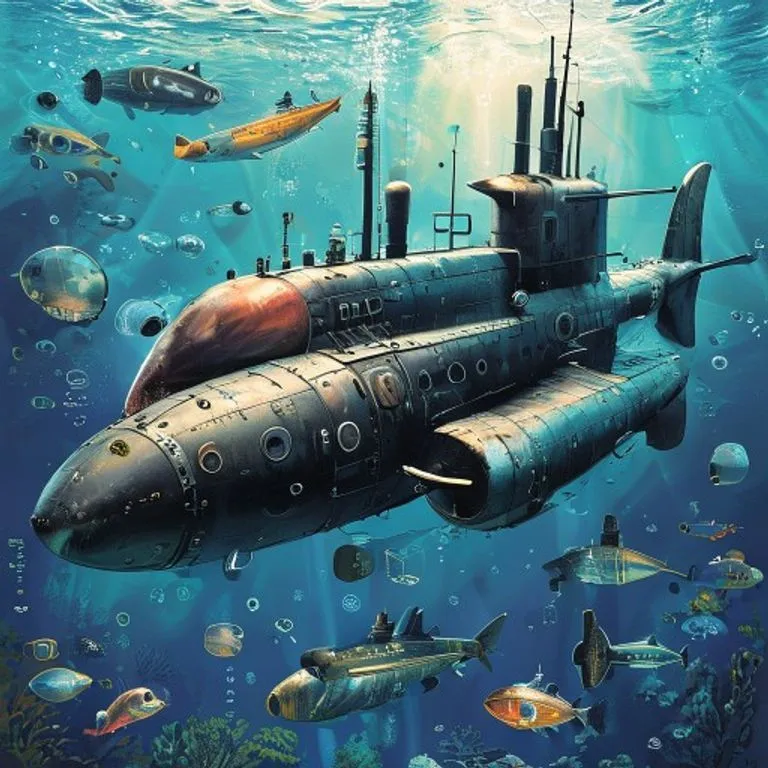
A watercraft capable of independent operation underwater. It differs from a submersible, which has more limited underwater capability. Submarines use buoyancy control to submerge and surface, and they are essential for underwater exploration, research, and naval operations.
Use / Function
- Underwater Exploration: Reaching depths inaccessible to divers for scientific study.
- Naval Operations: Stealthy transport, surveillance, and strategic presence.
- Research: Marine biology, geology, and oceanography.
- Salvage and Repair: Locating and working on underwater structures or shipwrecks.
Operating principle
Submarines operate based on Archimedes’ principle and buoyancy control.
- Buoyancy: A submarine has ballast tanks that can be filled with either water or air.
- Submerging: To submerge, the ballast tanks are vented of air and filled with Water, increasing the submarine’s density until it is greater than the surrounding water (negative buoyancy).
- Surfacing: To surface, compressed air is blown into the ballast tanks, forcing the water out and decreasing the submarine’s density until it is less than the surrounding water (positive buoyancy).
- Propulsion: Usually powered by a Diesel Engine on the surface and an Electric Motor powered by Batteries when submerged (in non-nuclear versions).
- Steering: Uses hydroplanes (underwater wings) to control pitch and a rudder to control yaw.
How to create it
Basic Functional Model
- Pressure Hull: A strong, watertight cylinder (usually Steel) designed to withstand the immense pressure of the depths.
- Ballast System: Tanks surrounding the pressure hull with valves to admit water and high-pressure air systems to expel it.
- Propulsion System: An engine or motor connected to a Propeller through a watertight seal.
- Life Support: Systems to recycle air, remove carbon dioxide, and provide oxygen (or simply a large enough air reservoir for short trips).
- Navigation: Instruments like a periscope for seeing above the surface and sonar for detecting objects underwater.
Materials needed
- Hull: High-strength Steel or Titanium (for extreme depths).
- Sealants: Heavy-duty rubber and specialized gaskets for hatches and propeller shafts.
- Ballast: Water and compressed air tanks.
- Power: Batteries and an Electric Motor.
- Windows: Thick acrylic or reinforced glass (if any).
Variants and improvements
- Submersible: Small, often unpowered or limited-range craft launched from a “mother ship.”
- Diesel-Electric: Uses diesel engines to charge batteries; can only stay submerged for limited times.
- Nuclear Submarine: Uses a nuclear reactor for power; can stay submerged almost indefinitely as it doesn’t need air for combustion.
- ROV/AUV: Remotely operated or autonomous underwater vehicles (unmanned).
Limits and risks
- Pressure: If the submarine exceeds its “crush depth,” the hull will collapse instantly.
- Air Quality: Carbon dioxide buildup is a constant threat in a sealed environment.
- Entanglement: Risk of getting caught in nets, cables, or underwater structures.
- Isolation: Limited communication with the surface and no easy escape in case of failure.