Generated with AI3 min read
Steam Locomotive
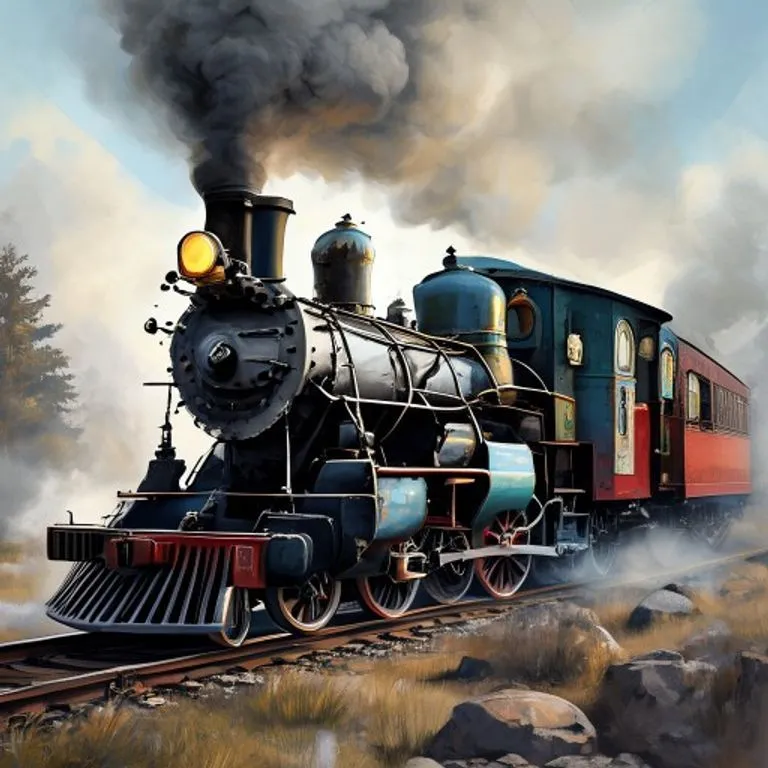
Brief description
A Steam Locomotive is a type of railway locomotive that produces its pulling power through a steam engine. These locomotives are fueled by burning combustible material—usually coal, wood, or oil—to heat water in a boiler, which creates steam under pressure. The steam then drives pistons that are connected to the locomotive’s main wheels.
Use / Function
- Heavy Transport: Moving large quantities of goods and materials (coal, ore, timber) over long distances.
- Passenger Transport: Revolutionized travel by allowing people to move between cities much faster than by horse-drawn carriage.
- Industrial Power: Used in mines, quarries, and factories for internal transport.
Operating principle
The steam locomotive is an application of the Steam Engine to a mobile platform:
- Combustion: Fuel (coal or wood) is burned in a firebox.
- Heat Transfer: The hot gases pass through tubes (fire-tubes) surrounded by water in a boiler.
- Steam Generation: The water boils, producing high-pressure steam.
- Expansion: The steam is directed into cylinders where it pushes a Piston back and forth.
- Transmission: The reciprocating motion of the piston is converted into rotary motion by a connecting rod and crank on the driving Wheel.
- Exhaust: Spent steam is exhausted through a blast pipe in the smokebox, which creates a draft to draw more air into the fire.
How to create it
- Level: Advanced.
- Boiler: A pressure vessel made of Steel or Iron plates riveted together. It must be able to withstand high pressures without exploding.
- Engine: A double-acting steam engine with a slide valve or piston valve to control steam flow.
- Chassis: A heavy frame to support the boiler and engine, mounted on axles and wheels.
- Drive System: Connecting rods and coupling rods to synchronize the wheels.
Materials needed
- Steel: For the boiler, frame, and rods.
- Iron and Cast Iron: For cylinders, wheels, and heavy components.
- Copper: Often used for the internal firebox due to its high thermal conductivity.
- Brass: For valves, gauges, and decorative fittings.
- Water: The working fluid.
- Coal or Wood: Fuel for the firebox.
Variants and improvements
- 0-4-0, 4-6-2 (Whyte notation): Different wheel arrangements for different speeds and pulling power.
- Compound Engine: Using the exhaust steam from one cylinder in a second, larger cylinder for better efficiency.
- Superheating: Reheating the steam to increase its energy and prevent condensation in the cylinders.
- Tender: A separate wagon behind the locomotive to carry extra fuel and water.
Limits and risks
- Efficiency: Steam locomotives are thermally inefficient (rarely exceeding 6-10%).
- Maintenance: Requires frequent cleaning (boiler scale removal), lubrication, and mechanical adjustment.
- Boiler Explosion: A catastrophic failure of the pressure vessel due to low water levels or excessive pressure.
- Fire Risk: Sparks from the chimney can ignite nearby fields or forests.