Generated with AI3 min read
Rail
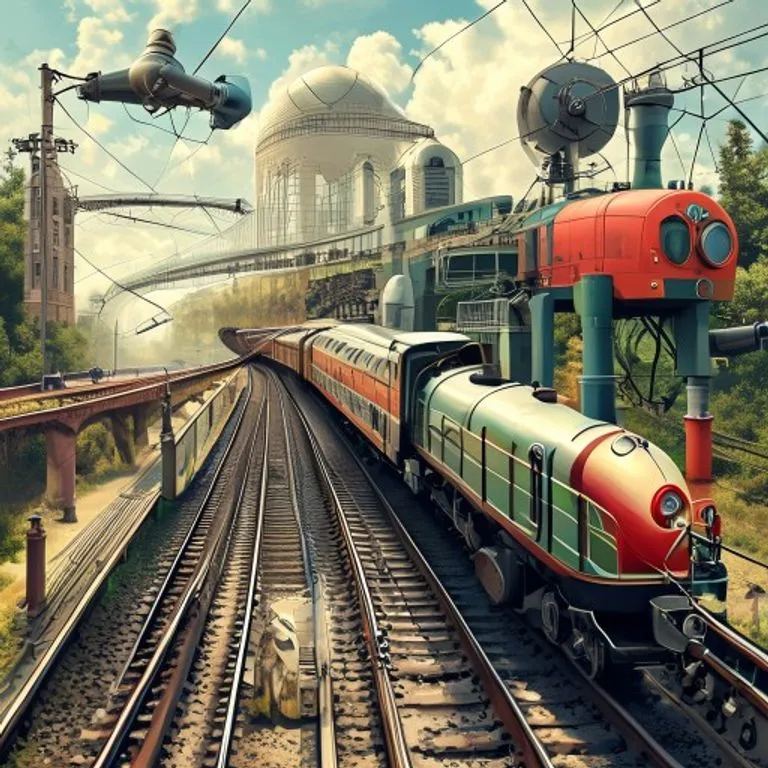
Brief description
A Rail is a bar of rolled steel forming a track for wheeled vehicles. Rails are laid on sleepers (ties) and ballast to form a permanent way for trains, trams, and mine carts.
Use / Function
- Transportation: The primary component of railway tracks, allowing for the efficient movement of heavy loads over long distances with low friction.
- Guidance: Flanges on the wheels run against the rails, steering the vehicle without the need for a driver to steer.
- Load Distribution: Spreads the immense weight of the train over a larger area of the ground (via sleepers and ballast).
Operating principle
The interaction between the steel wheel and the steel rail produces very low rolling friction, making rail transport extremely energy-efficient. The rail acts as a smooth, hard surface that resists deformation under heavy loads.
How to create it
- Material Production: Produce high-quality Steel (originally Iron) with specific properties for hardness and toughness.
- Rolling: Heat the steel billet to white-hot temperatures and pass it through a Rolling Mill with specially shaped rolls to form the “I” beam profile (T-rail).
- Cooling and Straightening: Controlled cooling to prevent warping, followed by straightening in a roller straightener.
- Laying: Fix the rails to Wood or Concrete sleepers (ties) using spikes or clips, maintaining a precise gauge (distance between rails).
Materials needed
- Rail: High-carbon Steel.
- Sleepers: Treated Hardwood or Prestressed Concrete.
- Ballast: Crushed Stone (Gravel) to drain water and lock the sleepers in place.
- Fasteners: Steel spikes, bolts, and clips.
Variants and improvements
- Strap Rail: An early form consisting of a thin iron strap nailed to a wooden rail (dangerous, as straps could peel up).
- Plateway: L-shaped rails where the flange is on the rail, not the wheel (obsolete).
- T-Rail (Vignoles): The standard modern rail profile with a flat bottom.
- Bullhead Rail: A reversible rail profile (common in the UK historically).
Limits and risks
- Thermal Expansion: Rails expand in heat and contract in cold. Gaps (expansion joints) or stressing (in continuously welded rail) are needed to prevent buckling (sun kinks).
- Wear: Curves and heavy braking cause wear on the rail head.
- Fracture: Internal defects in the steel can lead to catastrophic rail breaks.