Generated with AI3 min read
Radar
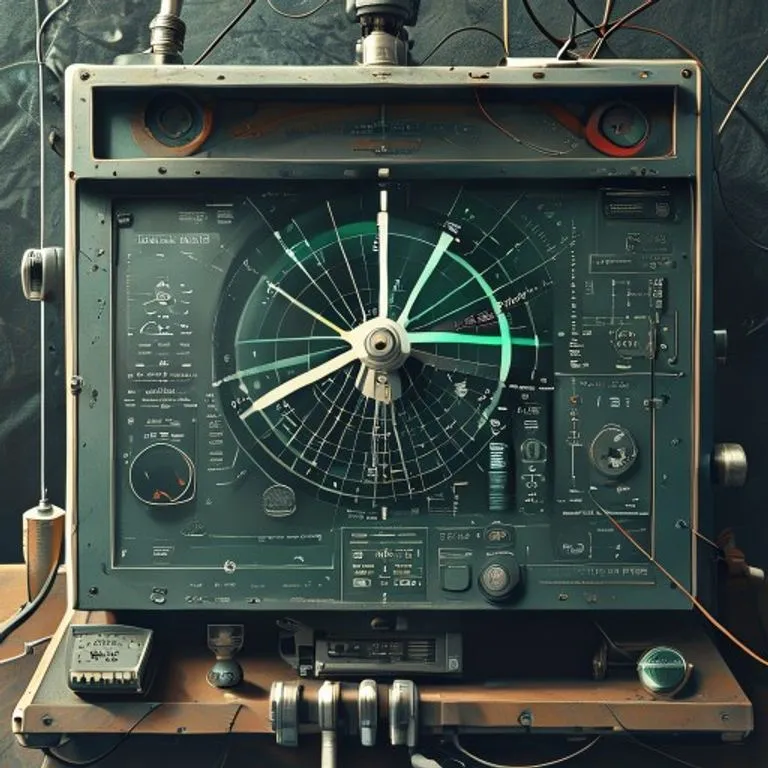
Brief description
Radar (Radio Detection and Ranging) is a detection system that uses radio waves to determine the distance (ranging), angle, or velocity of objects. It can detect aircraft, ships, spacecraft, and weather formations.
Use / Function
- Aviation: Air traffic control and aircraft navigation.
- Maritime: Ship navigation and collision avoidance, especially in fog or darkness.
- Military: Surveillance, target tracking, and missile guidance.
- Meteorology: Tracking storms and precipitation (Weather Radar).
- Speed Detection: Used by police to monitor vehicle speeds.
Operating principle
Radar works by emitting radio pulses and listening for their echoes.
- Transmission: A transmitter generates a high-frequency radio signal.
- Emission: An antenna directs the signal as a beam into space.
- Reflection: When the pulse hits an object, a small portion of the energy is reflected back toward the radar.
- Reception: The same antenna (or a different one) captures the weak echo.
- Processing: A receiver amplifies the echo. The time delay between transmission and reception determines the distance (speed of light is constant).
How to create it
Creating a functional radar is a high-technology task:
- Magnetron or Klystron: High-power vacuum tubes required to generate microwave frequencies.
- Antenna: Usually a parabolic dish to focus the waves.
- Duplexer: A switch that allows the same antenna to both transmit and receive.
- Signal Processor: Electronics to convert the echoes into a visual display or data.
- Technical level: Very Advanced.
Materials needed
- Essential materials:
- Tools:
- Oscilloscope: To visualize and tune the radio pulses.
- Lathe: For precise construction of microwave components.
Variants and improvements
- Pulse Radar: Sends short bursts (most common).
- Continuous Wave (CW): Sends a constant signal (used for speed detection via Doppler effect).
- Phased Array: Uses a grid of small antennas to steer the beam electronically without moving parts.
- Synthetic Aperture Radar (SAR): Uses the motion of the radar to create high-resolution images.
Limits and risks
- Stealth: Objects can be designed to absorb or scatter radar waves, making them “invisible.”
- Interference: Can be “jammed” by other powerful radio sources.
- Horizon: Traditional radar cannot “see” beyond the horizon due to the curvature of the Earth (unless using Over-the-Horizon techniques).
- Radiation: High-power radar beams can be hazardous to living tissue at close range.
Related Inventions
- Radio: The foundational technology for transmitting waves.
- Vacuum Tube: Essential for early high-frequency generation.