Generated with AI3 min read
Centrifuge
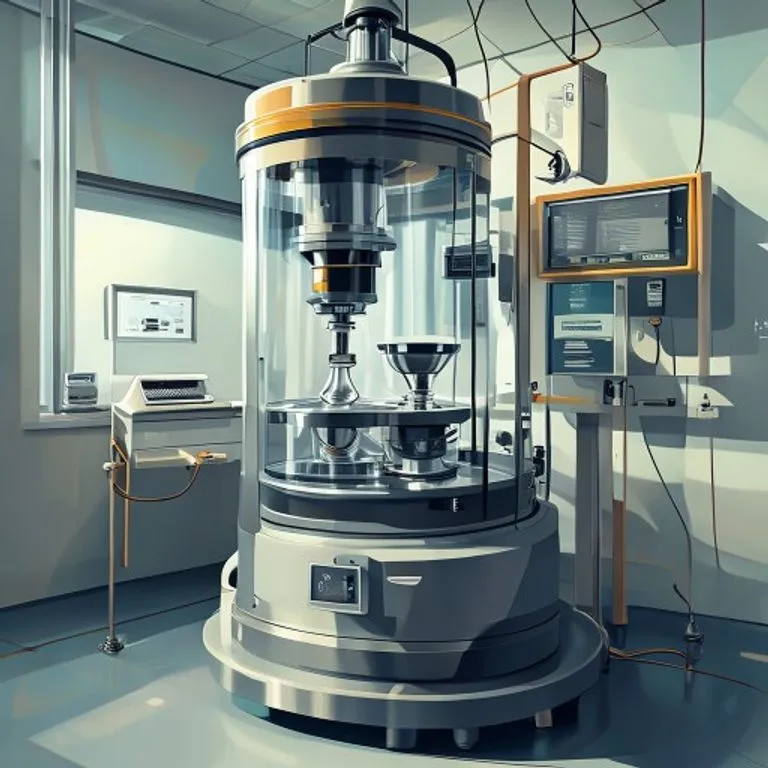
Brief description
A device that uses centrifugal force to separate substances of different densities. By spinning a mixture at high speeds, the denser components are pushed to the outside (or bottom) of the container, while the less dense components move toward the center.
Use / Function
- Primary use: Separating liquids from solids or separating two liquids of different densities (e.g., cream from milk).
- Scientific use: Separating blood components (plasma and cells), isolating precipitates in chemical reactions, and isotope separation.
- Industrial use: De-watering sludge, refining oils, and enriching materials.
- Scale: From small hand-cranked laboratory units to massive industrial separators.
Operating principle
The centrifuge exploits the principle of inertia and centripetal acceleration:
- Rotation: The mixture is placed in a container (vial or bowl) attached to a central axis.
- Acceleration: The axis is spun rapidly.
- Sedimentation: According to Newton’s first law, the components “want” to travel in a straight line. The container forces them into a curve.
- Separation: Denser particles have more inertia and are forced more strongly toward the periphery of the rotation. Over time, the components form distinct layers based on their density.
How to create it
A basic functional centrifuge can be hand-powered or attached to a motor.
- Rotor: A balanced arm or disk that holds the samples. It must be perfectly symmetrical to prevent dangerous vibrations at high speeds.
- Drive Mechanism: A system to achieve high RPM. For a hand-powered version, a high-ratio gear system (like a Hand Mill or modified Drill Press) is essential.
- Bearings: High-quality Ball and Roller Bearings are critical to minimize friction and handle the radial loads.
- Containment Shield: A strong outer casing (Steel or heavy Wood) to protect the operator in case the rotor or sample containers fail.
- Sample Holders: Buckets or tubes, often made of Glass or metal, that can pivot or are angled to allow sedimentation.
Materials needed
- Rotor and Shaft: Steel for its high strength-to-weight ratio and ability to withstand tension.
- Frame: Heavy Cast Iron to provide stability and dampen vibrations.
- Sample Containers: Strong Glass (like borosilicate) or high-strength metal tubes.
- Transmission: Gears and Chains or belts to transfer power from the source to the rotor.
Variants and improvements
- Cream Separator: A specialized centrifuge designed to separate cream from whole milk.
- Ultracentrifuge: Capable of extremely high speeds (hundreds of thousands of RPM), used to separate molecular-scale components.
- Decanter Centrifuge: A continuous-flow version used for large-scale industrial separation of solids from liquids.
Limits and risks
- Imbalance: Even a tiny weight difference between opposite samples can cause the machine to vibrate violently and disintegrate at high speeds.
- Mechanical Failure: The stresses on the rotor are immense; if it fails, it becomes a high-speed projectile.
- Heat: Friction with air or within the bearings can heat the samples, which may be undesirable for biological materials.