Generated with AI2 min read
Manual Mill (grain)
Brief description
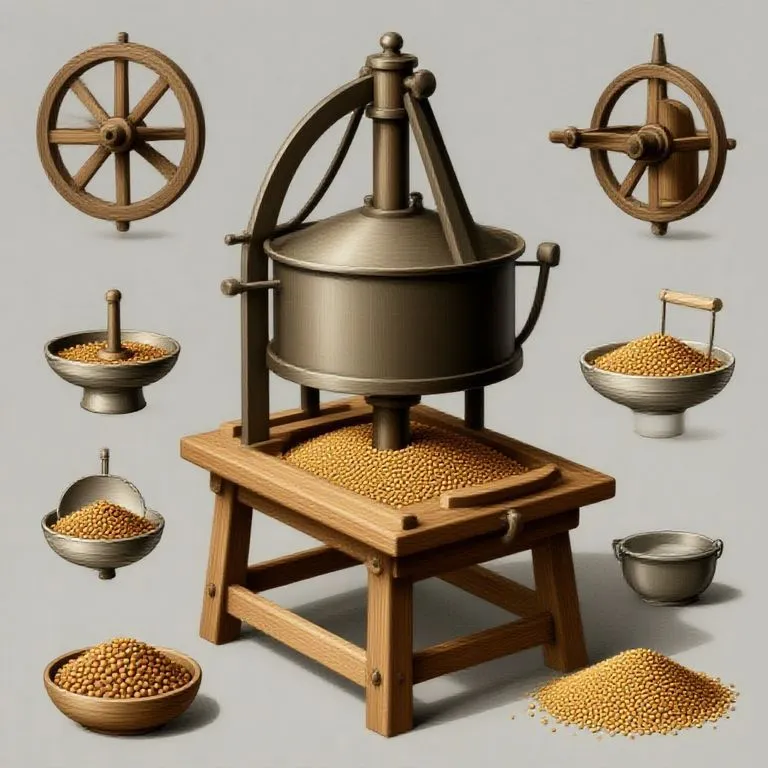
A manual mill, specifically a hand mill or quern, is a simple tool used for grinding grain into flour by hand. It was a staple of domestic life for millennia before the advent of large-scale industrial milling.
Use / Function
- Flour production: Grinding wheat, barley, corn, or other grains.
- Spice grinding: Pulverizing seeds and dried herbs for Spices.
- Small-scale processing: Ideal for individual households or small groups.
Operating principle
The hand mill works through friction and pressure between two abrasive surfaces:
- Saddle Quern: A flat or concave stone (the bedstone) and a smaller handheld stone (the rubber or muller) that is pushed back and forth.
- Rotary Quern: Two circular stones; the top stone (runner) is rotated by a handle over a stationary bottom stone (bedstone). Grain is fed through a hole in the center of the top stone.
How to create it
To make a simple rotary hand mill:
- Stone Selection: Find two thick, flat stones of hard, abrasive rock (like basalt or granite).
- Shaping: Carve both stones into circular shapes.
- Drilling: Drill a central hole in the top stone for the grain feed and a smaller off-center hole for the handle.
- Assembly: Place the top stone on a central spindle (wooden or metal) fixed to the bottom stone to keep them aligned.
Materials needed
- Essential: Hard, non-crumbly stone.
- Tools: Stone chisels or harder stones for carving.
- Handle: A sturdy wooden stick.
Variants and improvements
- Saddle Quern: The most primitive form, using back-and-forth motion.
- Rotary Quern: A major improvement using circular motion, which is more efficient.
- Adjustable Gap: Adding a mechanism to raise or lower the top stone to control the fineness of the flour.
Limits and risks
- Physical Labor: Requires significant physical effort and time to produce even small amounts of flour.
- Stone Dust: Tiny fragments of the millstone can end up in the flour, which can wear down teeth over time.
- Maintenance: The grinding surfaces must be periodically roughened (dressed) with a chisel to remain effective.