Generated with AI3 min read
Ammonia Production
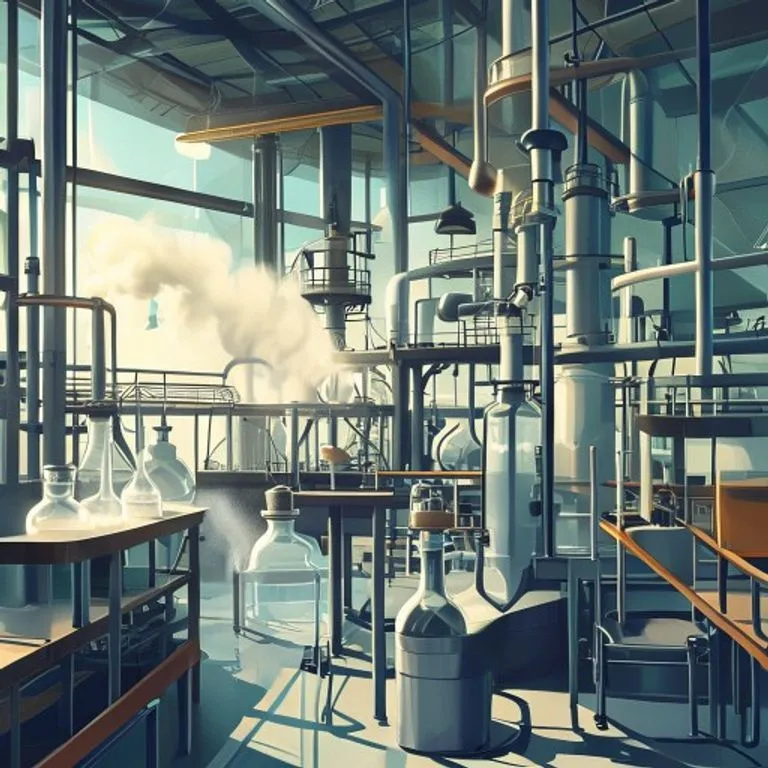
Brief description
Ammonia production via the Haber-Bosch process is the industrial method for synthesizing ammonia from atmospheric nitrogen and hydrogen gas. This invention is perhaps the most significant of the 20th century, as it enabled the mass production of synthetic fertilizers, which currently sustain about half of the global population.
Use / Function
- Primary use: Production of ammonia for synthetic fertilizers.
- Secondary uses: Manufacturing explosives, Refrigerants, and cleaning agents.
- Scale: Large-scale industrial plants.
Operating principle
- Nitrogen Extraction: Nitrogen is obtained from the air (which is ~78% nitrogen) through fractional distillation of liquid air or other separation methods.
- Hydrogen Production: Hydrogen is typically obtained from natural gas (methane) via steam reforming, or from water via electrolysis.
- Compression: The nitrogen and hydrogen gases are mixed in a 1:3 ratio and compressed to very high pressures (150–250 bar).
- Reaction: The compressed gases are heated to 400–500°C and passed over an Iron catalyst.
- Haber Process: Under these conditions, nitrogen and hydrogen react to form Ammonia: N2 + 3H2 ⇌ 2NH3.
- Cooling and Recirculation: The ammonia is cooled and liquefied for collection, while the unreacted nitrogen and hydrogen are recirculated back into the reactor.
How to create it
Industrial Scale Requirements
- High-Pressure Reactor: A massive steel vessel capable of withstanding extreme pressures and temperatures.
- Compressors: Powerful machinery to bring the gases to the required pressure.
- Heat Exchangers: To manage the thermal energy of the reaction (the reaction is exothermic).
- Catalyst: Finely divided Iron with promoters (like potassium and aluminum oxides) to speed up the reaction.
- Gas Purification: Systems to remove impurities (like CO or sulfur) that would “poison” the catalyst.
- Technical level: Advanced (requires high-precision engineering and metallurgy).
Materials needed
- Essential: Nitrogen (from air), Hydrogen (from water or hydrocarbons), Iron (catalyst).
- Equipment: Steel for pressure vessels, Pipes, Valves, Pumps, and Air Compressors.
- Fuel: Coal or natural gas to provide heat and hydrogen.
Variants and improvements
- Original Haber Process: Used osmium or uranium catalysts (too expensive). Bosch scaled it up using iron.
- Modern Optimization: Improved catalysts and better heat integration have significantly increased efficiency.
- Green Ammonia: Using renewable energy (wind/solar) to power electrolysis for hydrogen production, making the process carbon-neutral.
Limits and risks
- Energy Intensive: Requires significant amounts of energy (mostly for compression and hydrogen production).
- Explosion Risk: Dealing with high-pressure hydrogen and ammonia poses significant safety risks if containment fails.
- Catalyst Poisoning: Trace amounts of oxygen or carbon monoxide can render the catalyst useless.
Related Inventions
- Steam Engine (for power/compression)
- Boiler
- Pump
- Valve
- Pipes
- Air Compressor
- Mechanical Refrigeration