Interchangeable Parts
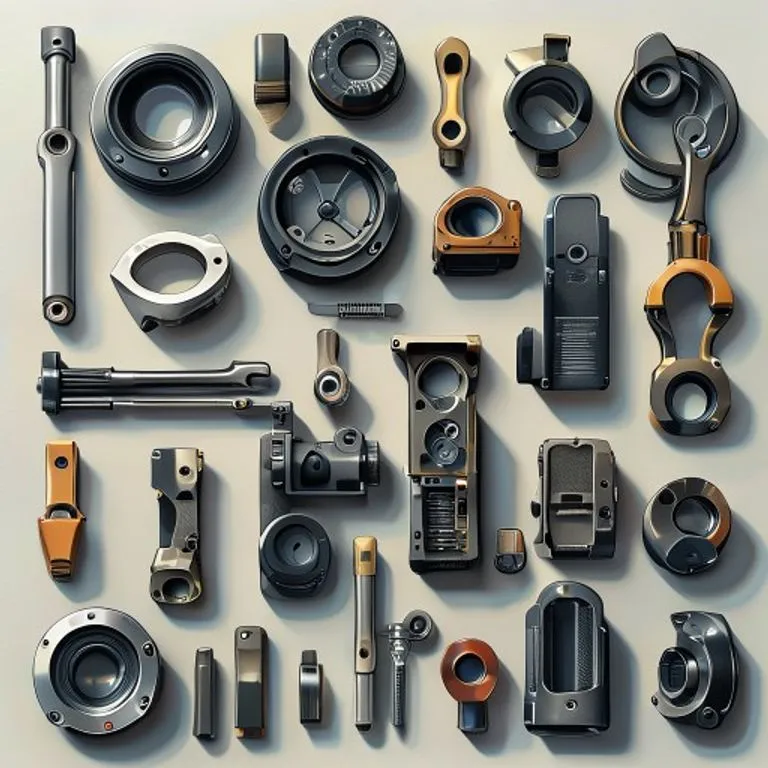
Brief description
Interchangeable parts are components that are made to such precise specifications that they are nearly identical and can fit into any assembly of the same type. One such part can freely replace another, without any custom fitting (such as filing). This concept is the foundation of modern mass production and the assembly line.
Use / Function
- Mass Production: Enables the rapid assembly of complex machines by semi-skilled labor.
- Repair and Maintenance: Allows for easy replacement of broken parts with standardized spares.
- Logistics: Simplifies the supply chain, as only one version of a part needs to be stocked.
- Reliability: Ensures that every finished product performs to the same standard.
Operating principle
The principle relies on Standardization and Precision Measurement.
- Uniformity: Every part must be manufactured within a very narrow range of acceptable dimensions (tolerances).
- Gauging: Using specialized tools (Go/No-Go gauges) to verify that parts meet the specifications.
- Specialized Tooling: Using jigs, fixtures, and machine tools (like the Lathe and Milling Machine) to ensure repeatability, rather than relying on the skill of a craftsman’s hand.
How to implement it
1. Design for Manufacture
Break down a machine into discrete components. Define exact dimensions and allowable tolerances for each.
2. Precision Tools
Create or obtain precision measuring instruments like Calipers and Micrometers. Establish a master standard (e.g., a set of gauge blocks) against which all other tools are calibrated.
3. Jigs and Fixtures
Build specialized guides (jigs) that hold the workpiece and guide the cutting tool in the exact same way every time. This removes human error from the shaping process.
4. Inspection
Implement a rigorous inspection process where every part is checked against a gauge before being sent to the assembly line.
Materials needed
- Master Gauges: Hardened Steel blocks or pins of known dimensions.
- Machine Tools: Lathe, Milling Machine, Drill Press.
- Measuring Instruments: Calipers, Micrometer, Ruler.
Variants and improvements
- Craftsmanship: (Contrast) Every part is custom-fitted to the next; parts are not interchangeable.
- Selective Assembly: Parts are measured and grouped by size; a “large” piston is matched with a “large” cylinder bore. (An intermediate step to full interchangeability).
- Statistical Process Control (SPC): Monitoring the manufacturing process in real-time to ensure parts stay within tolerance.
Limits and risks
- High Initial Cost: Setting up the jigs and specialized machinery is very expensive and only pays off with high-volume production.
- Tolerance Stack-up: If several parts are all at the extreme edge of their allowed tolerance, the final assembly may not fit or function correctly.
- Rigidity: Once the specialized tooling is built, it is difficult and expensive to change the design of the product.
Related Inventions
- Lathe
- Milling Machine
- Calipers
- Micrometer
- Printing Press (An early application of interchangeable type)